
Why Traditional Technical SEO Checklists Are Failing in 2025
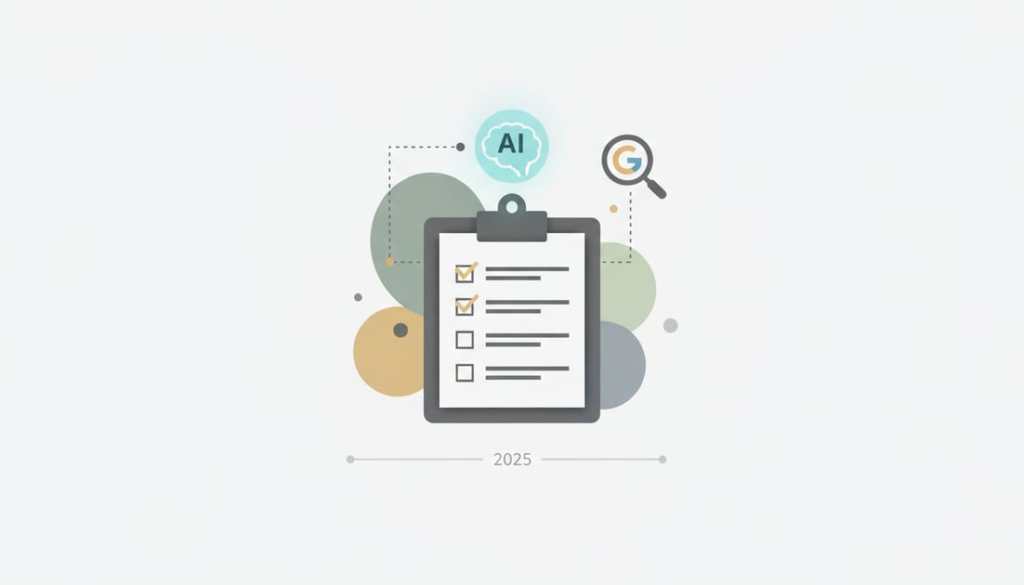
Your technical SEO checklist worked brilliantly in 2023. Fast forward to 2025, and the same optimisations deliver diminishing returns. The problem isn’t your execution – it’s that the search landscape has fundamentally changed.
Traditional checklists were built for crawler-based search engines. They focused on helping Googlebot find and index your pages efficiently. That approach still matters, but it’s no longer sufficient. AI-powered search experiences now dominate the Search Engine Results Page (SERP), with AI Overviews appearing in prominent positions and reducing organic click-through rates by up to 60% for certain queries.
The shift creates three critical gaps in conventional technical SEO approaches:
- Comprehension over crawling: AI engines like ChatGPT and Gemini require semantic understanding, not just crawlability. Your content needs to answer questions with depth, not simply rank for micro-keywords.
- Zero-click visibility: When AI generates answers directly in search results, traditional ranking metrics become incomplete. You need new performance metrics that track AI citation and feature appearances.
- Geo-legibility failures: AI systems struggle with geographic identification, meaning international SEO requires explicit location signals beyond standard hreflang implementation.
This guide provides an updated technical SEO checklist that addresses both traditional ranking factors and AI-era requirements. SEO Engico Ltd has developed frameworks that extend beyond static checklists to adaptive visibility strategies. Real links. Real results.
Understanding AI-Era Technical SEO: What’s Changed in 2025
The architecture of search has evolved beyond pattern matching to genuine comprehension. AI-powered crawlers now employ deep learning and natural language processing to extract semantic meaning from content, fundamentally altering how search engines evaluate and index websites.
This transformation impacts every layer of understanding technical SEO. Where traditional crawlers followed links and counted keywords, AI systems analyse context, intent, and relationships between concepts. They prioritise content based on relevance signals that extend far beyond meta tags and header hierarchies.
The practical implications reshape your entire technical audit approach:
- Dynamic prioritisation: AI crawlers use reinforcement learning to adapt their indexing behaviour based on content quality signals, not just structural elements
- Entity recognition: Search systems now identify and connect entities within your content, making structured data implementation more critical than ever
- Semantic indexing: Pages get evaluated on topical authority and conceptual depth rather than isolated keyword density
Your technical foundation must now support both machine readability and machine understanding. Schema markup becomes a communication protocol with AI systems. Page speed affects not just user experience but how efficiently AI crawlers can process your semantic signals. Internal linking structures help AI systems map your site’s knowledge architecture.
The technical SEO audit checklist you implement determines whether AI systems can fully comprehend and represent your content in generative results.
Core Technical SEO Foundations That Still Matter
AI systems require sophisticated understanding capabilities, but they still depend on fundamental infrastructure to access and process your content. These core technical elements form the bedrock upon which AI comprehension is built.
1. Crawlability Architecture – Ensure Search Engines Can Access Your Pages
Your robots.txt file and XML sitemap remain critical navigation tools for both traditional crawlers and AI-powered systems. Configure robots.txt to permit access to essential resources whilst blocking low-value pages that waste crawl budget. Submit comprehensive XML sitemaps through Google Search Console to guide discovery of priority content.
Tip
Monitor crawl stats in Google Search Console weekly to identify pages that consume excessive crawl budget without delivering indexing value.
2. Indexability Controls – Direct Which Pages Appear in Search Results
Meta robots tags and canonical URLs prevent duplicate content issues that confuse AI systems attempting to identify authoritative sources. Use noindex directives strategically for thin content whilst implementing canonical tags to consolidate ranking signals across similar pages.
3. Site Architecture Hierarchy – Create Logical Content Relationships
Flat site structures reduce click depth and help AI crawlers understand content importance through proximity to your homepage. Implement breadcrumb navigation and logical URL structures that reflect topical hierarchies.
| Architecture Element | Traditional Benefit | AI-Era Benefit |
|---|---|---|
| Shallow click depth | Faster indexing | Enhanced topic clustering |
| Descriptive URLs | User clarity | Entity recognition signals |
| Internal linking | PageRank flow | Semantic relationship mapping |
4. Technical Health Monitoring – Identify Infrastructure Issues
Regular audits using platforms like Ahrefs or SEMrush surface broken links, redirect chains, and server errors that block crawler access. Address 404 errors promptly and minimise redirect hops to preserve crawl efficiency.
SEO Engico Ltd delivers comprehensive technical audits covering crawlability and indexability infrastructure that supports both traditional and AI-powered search systems.
AI Bot Optimisation: Preparing Your Site for LLM Crawlers
Large language model crawlers from OpenAI GPTBot, ChatGPT, and Bing Copilot require specialised technical configurations beyond traditional crawler optimisation. These AI systems extract semantic meaning and contextual relationships, demanding explicit machine-readable structures that communicate your content’s purpose and authority.
Step 1: Deploy llms.txt Files for AI Discovery
Create an llms.txt file in your root directory to guide AI crawlers towards priority content and define access permissions. This emerging standard helps LLM systems identify authoritative pages whilst respecting content boundaries. txt
llms.txt
Priority content for AI systems
Allow: /guides/ Allow: /resources/ Disallow: /admin/ Preferred-Sources: /technical-seo/, /link-building/
Place this file at yourdomain.com/llms.txt alongside your robots.txt configuration.
Step 2: Configure Robot Directives for AI Crawlers
AI bot user agents require specific robots.txt entries. Control access for GPTBot, Claude-Web, and other LLM crawlers independently from traditional search engine directives. txt User-agent: GPTBot Allow: /blog/ Disallow: /private/
User-agent: Claude-Web Allow: /
Tip
Monitor crawler behaviour through server logs to identify which AI systems access your content and adjust permissions accordingly.
Step 3: Implement Semantic HTML5 Elements
Research demonstrates that semantic HTML significantly improves AI comprehension of web content structure. Replace generic <div> containers with meaningful elements like <article>, <section>, <nav>, and <aside>.
| Generic Markup | Semantic Alternative | AI Benefit |
|---|---|---|
| Content boundary recognition | ||
| Navigation context understanding | ||
| Supplementary content identification |
Step 4: Structure Content with Schema Markup
AI systems rely on structured data to extract entity relationships and topical authority signals. Implement schema markup for articles, products, FAQs, and organisational information using JSON-LD format. json { “@context”: “https://schema.org“, “@type”: “TechArticle”, “headline”: “Technical SEO Checklist”, “author”: { “@type”: “Organization”, “name”: “SEO Engico Ltd” } }
Validate your structured data through Google Search Console to ensure AI crawlers can parse your semantic signals correctly.
Schema Markup Strategy for AI Search Visibility
AI systems like ChatGPT and Google SGE extract structured data as grounding signals for generating answers. When you implement precise schema markup, you increase the probability that AI engines cite your content in their responses by providing machine-readable context that supplements natural language processing.
Schema.org vocabularies translate your content into formats that AI systems parse during indexing. These structured signals help LLMs categorise information, establish entity relationships, and verify factual accuracy before inclusion in generated answers.
Priority Schema Types for AI Visibility
Deploy these schema implementations to maximise AI comprehension and citation potential:
FAQPage Schema – Structure question-answer pairs that AI systems extract directly for conversational responses. This format signals explicit query-answer relationships that match natural language patterns. json { “@context”: “https://schema.org“, “@type”: “FAQPage”, “mainEntity”: [{ “@type”: “Question”, “name”: “What is technical SEO?”, “acceptedAnswer”: { “@type”: “Answer”, “text”: “Technical SEO optimises website infrastructure for crawler access and AI comprehension.” } }] }
HowTo Schema – Define step-by-step processes that AI engines reference when answering procedural queries. Include explicit steps, tools, and estimated completion times.
Author and Organization Schema – Establish content provenance and expertise signals. AI systems evaluate source authority when determining citation worthiness, making authorship markup essential for E-E-A-T validation.
Product and Review Schema – Enable AI systems to extract pricing, availability, and rating data that informs product recommendations within generative answers.
Tip
Validate all schema implementations through Google Search Console rich results testing to ensure AI crawlers parse your markup correctly.
Advanced Entity Markup Techniques
Connect related concepts through entity relationships using sameAs properties that link to authoritative knowledge bases. Reference Wikipedia, Wikidata, or industry databases to reinforce entity recognition.
Implement nested schema types that create hierarchical relationships between content elements. Combine Article schema with Author, Organization, and BreadcrumbList schemas to build comprehensive semantic graphs.
Monitor which schema types generate AI citations by tracking referral patterns and zero-click impressions. Adjust your schema markup strategy based on which structured data formats produce measurable visibility in AI-generated responses.
Core Web Vitals and Performance Optimisation for 2025
Performance metrics directly influence both traditional rankings and AI search visibility. AI systems prioritise fast-loading, responsive content when selecting sources for generated answers, making speed optimisation a dual-purpose investment that serves user experience and algorithmic requirements simultaneously.
1. Interaction to Next Paint (INP) – Measure Responsiveness Accurately
INP replaced First Input Delay in March 2024 as the definitive responsiveness metric. This measurement captures the delay between user interactions and visual feedback across the entire page lifecycle. Target INP values below 200 milliseconds to achieve “good” status. Identify slow interactions through PageSpeed Insights field data, then optimise JavaScript execution and reduce main thread blocking.
2. Largest Contentful Paint (LCP) – Optimise Loading Performance
LCP measures perceived loading speed by tracking when the largest visible element renders. Achieve sub-2.5 second LCP through image optimisation, server response improvements, and resource prioritisation. Implement preload directives for critical assets and use Content Delivery Network (CDN) distribution to reduce latency across geographic regions.
| Core Web Vital | Good Threshold | Poor Threshold | Primary Impact |
|---|---|---|---|
| INP | ≤ 200ms | > 500ms | Interaction responsiveness |
| LCP | ≤ 2.5s | > 4.0s | Perceived load speed |
| CLS | ≤ 0.1 | > 0.25 | Visual stability |
3. Cumulative Layout Shift (CLS) – Eliminate Visual Instability
CLS quantifies unexpected layout movements that frustrate users and disrupt AI crawler rendering. Reserve explicit dimensions for images, advertisements, and embeds to prevent content shifting during page load. Maintain CLS scores below 0.1 through proper sizing attributes and font loading strategies.
Tip
Monitor Core Web Vitals through Google Search Console to identify pages failing thresholds and prioritise performance enhancements based on traffic impact.
4. Mobile Performance Prioritisation – Address Mobile-First Indexing
AI systems evaluate mobile performance as the primary ranking signal. Compress images using modern formats like WebP, minimise render-blocking resources, and implement lazy loading for below-fold content. Your AI technical SEO audit should benchmark mobile metrics separately from desktop performance.
Speed improvements reduce bounce rates whilst increasing the probability that AI crawlers successfully extract and index your semantic content before timeout thresholds.
Content Structure for AI Extraction and Citation
AI systems extract and cite content through pattern recognition and semantic parsing. Your on-page formatting determines whether LLMs accurately interpret your expertise and reference your pages in generated responses.
Step 1: Implement TL;DR Sections for Rapid Comprehension
Position concise summary blocks at the beginning of long-form content. AI crawlers prioritise these condensed overviews when generating quick answers, increasing citation probability for featured snippets and conversational responses. html
TL;DR: Technical SEO in 2025 requires AI-optimised content structure, semantic headings, and entity-rich formatting that supports both human readers and machine comprehension.
Place TL;DR blocks immediately after your H1 heading to establish context before detailed exploration begins.
Step 2: Deploy Semantic Heading Hierarchies
Structure headings as descriptive topic signals rather than generic labels. AI systems parse H2-H6 tags to map content architecture and extract topical relationships between sections.
| Weak Heading | Semantic Alternative | AI Extraction Benefit |
|---|---|---|
| “Overview” | “How AI Crawlers Parse Technical SEO Elements” | Query-answer alignment |
| “Tips” | “Five Methods to Improve Schema Markup Accuracy” | Numbered list recognition |
| “More Information” | “Entity Disambiguation Through Structured Data” | Concept boundary clarity |
Maintain strict hierarchical order without skipping levels. AI parsers interpret heading structure as a knowledge taxonomy that defines content importance and relationships.
Tip
Include target keywords naturally within H2 headings to reinforce topical relevance whilst maintaining semantic clarity for AI extraction systems.
Step 3: Format Content for Scannability
Break dense paragraphs into digestible segments using bullet lists, tables, and code blocks. Research demonstrates that structured formatting improves AI extraction accuracy by providing clear content boundaries and relationship markers.
Use bold text to emphasise key concepts and entities. AI systems weight visually distinguished terms higher during semantic analysis, increasing the likelihood of accurate entity recognition and citation.
Step 4: Establish Entity Clarity Through Explicit Naming
Reference people, organisations, products, and concepts using their complete formal names on first mention. Link entities to authoritative knowledge bases through schema markup and contextual hyperlinks that reinforce entity relationships. json { “@type”: “Organization”, “name”: “SEO Engico Ltd”, “sameAs”: “https://seoengico.com/” }
Avoid pronouns and ambiguous references when discussing technical concepts. Explicit entity naming reduces disambiguation errors that prevent AI systems from accurately attributing information to your content during answer generation.
Monitor which content formats generate citations by tracking zero-click impressions and AI referral patterns through analytics platforms.
International and Multi-Language Technical SEO Considerations
International technical SEO demands explicit geographic and linguistic signals that AI systems can parse without ambiguity. Whilst traditional crawlers relied on IP detection and domain extensions, AI-powered search requires structured markup that communicates regional targeting through machine-readable protocols.
Hreflang Implementation for Cross-Regional Visibility
Deploy hreflang annotations to specify language and regional variations of your content. These tags prevent duplicate content penalties whilst directing users and AI crawlers to appropriate language versions based on search context. html
Include a self-referencing hreflang tag and reciprocal annotations across all language variants. Validate implementation through Google Search Console to identify missing return tags or incorrect language codes.
Warning
Mixing hreflang with conflicting canonical tags creates indexing conflicts. Ensure canonical URLs point to the same language version referenced by hreflang attributes.
Geographic Targeting Beyond Hreflang
AI systems struggle with implicit location signals, requiring explicit geo-targeting through multiple channels. Configure regional preferences in Search Console, implement LocalBusiness schema with address data, and use country-specific domains or subdirectories with clear URL structures.
| Targeting Method | AI Comprehension | Implementation Complexity |
|---|---|---|
| ccTLD domains | Strongest signal | High maintenance |
| Subdirectories | Moderate clarity | Lower overhead |
| Schema geo-data | Enhanced context | Technical precision |
Combine hreflang with structured geographic data to reinforce regional relevance. SEO Engico Ltd implements comprehensive international frameworks that address both traditional ranking factors and AI-era geographic disambiguation requirements across multi-regional deployments.
Security, HTTPS, and Trust Signals for AI Search
AI systems evaluate security protocols as fundamental trust indicators when determining citation worthiness. HTTPS implementation, E-E-A-T signals, and security configurations communicate content reliability to both traditional crawlers and large language models assessing source credibility.
1. HTTPS Migration as Baseline Requirement – Establish Encrypted Connections
HTTPS has functioned as a confirmed ranking factor since 2014, but AI-powered search systems treat SSL certificates as non-negotiable trust signals. Migrate all pages to HTTPS using 301 redirects, update internal links to HTTPS versions, and implement HTTP Strict Transport Security (HSTS) headers to enforce secure connections.
Strict-Transport-Security: max-age=31536000; includeSubDomains; preload
Verify SSL certificate validity through browser developer tools and address mixed content warnings that undermine security signals.
2. E-E-A-T Signal Implementation – Demonstrate Expertise and Authority
AI crawlers assess Experience, Expertise, Authoritativeness, and Trustworthiness through author credentials, citation patterns, and organisational transparency. Display author biographies with professional qualifications, link to authoritative external sources, and maintain updated contact information with verified business details.
| E-E-A-T Component | Implementation Method | AI Signal Strength |
|---|---|---|
| Author credentials | Schema Person markup | High |
| External citations | Links to .edu/.gov | Moderate |
| Contact transparency | Organization schema | High |
3. Security Headers and Technical Trust Indicators – Configure Server-Level Protections
Deploy Content Security Policy (CSP) headers, X-Frame-Options, and X-Content-Type-Options to prevent security vulnerabilities. AI systems interpret these configurations as signals of technical sophistication and content integrity.
Tip
Monitor security headers through web hosting configurations and validate implementation using security scanning platforms to maintain trust signals AI crawlers evaluate during indexing.
Combine HTTPS with comprehensive E-E-A-T markers to maximise AI citation probability across generative search experiences.
Technical SEO Audit Process: Tools and Methodology
Conducting a comprehensive technical audit requires systematic evaluation across multiple diagnostic layers. This framework combines traditional crawl analysis with AI-specific monitoring to identify visibility gaps across both conventional search and generative experiences.
Step 1: Establish Baseline Performance Metrics
Begin by documenting current search visibility across traditional and AI-powered platforms. Access Google Search Console to extract impression data, average position, and click-through rates over the previous 90 days. Record Core Web Vitals performance through PageSpeed Insights for both mobile and desktop versions of priority pages.
Track AI search appearances across ChatGPT, Google SGE, and Bing Copilot using specialised monitoring platforms that capture citation frequency and feature placements. Traffic from ChatGPT search is projected to overtake organic search traffic by 2028, making baseline AI visibility measurement essential.
Step 2: Execute Comprehensive Site Crawl
Deploy Screaming Frog SEO Spider to audit technical infrastructure. Configure custom extraction for schema markup validation, hreflang verification, and canonical tag accuracy. Export crawl data identifying broken links, redirect chains exceeding two hops, orphaned pages lacking internal links, and duplicate content patterns.
Tip
Limit crawl depth to three clicks from the homepage initially, then expand to isolated sections requiring deeper analysis based on priority content segments.
Step 3: Analyse Crawl Budget Allocation
Examine server log files to determine how Googlebot and AI crawlers distribute attention across your site architecture. Identify pages consuming excessive crawl budget relative to their indexing value. Cross-reference log data with Google Search Console crawl stats to detect pages crawled frequently but rarely indexed.
| Audit Platform | Primary Function | AI-Era Application |
|---|---|---|
| Screaming Frog | Infrastructure crawl | Schema validation |
| PageSpeed Insights | Performance metrics | LCP/INP optimisation |
| AI monitoring platforms | Citation tracking | Multi-platform visibility |
Step 4: Validate Structured Data Implementation
Test schema markup accuracy through Google Search Console rich results reporting. Verify JSON-LD syntax, confirm entity relationships align with content context, and ensure breadcrumb markup reflects actual site hierarchy. Address validation errors that prevent AI systems from parsing semantic signals correctly.
Step 5: Prioritise Remediation Based on Impact
Rank identified issues by traffic potential and fix complexity. Address critical crawlability blockers first, followed by indexability conflicts, then performance optimisations. Document enhancements through technical SEO resources that track implementation progress and measure visibility improvements across traditional and AI search channels.
Common Technical SEO Mistakes That Block AI Visibility
A major e-commerce platform discovered their robots.txt file blocked GPTBot and Claude-Web entirely, preventing AI systems from indexing 40,000 product pages. When they corrected the directive, ChatGPT citations increased 180% within six weeks. This scenario illustrates how invisible configuration errors sabotage AI visibility whilst traditional search performance appears normal.
Critical Errors That Prevent AI Discovery
Blocking AI Crawlers Through Robots.txt Mistakes – Research examining AI crawler behaviour in 2025 reveals widespread compliance issues where defensive robots.txt configurations inadvertently exclude legitimate LLM systems. Publishers blocking User-agent: * prevent AI discovery without realising newer bots require explicit permission statements. txt
Blocks AI crawlers unintentionally
User-agent: * Disallow: /
Correct approach
User-agent: GPTBot Allow: / User-agent: Claude-Web Allow: /
Semantic HTML Neglect – Sites built entirely with <div> containers force AI systems to guess content boundaries. When you replace generic markup with <article>, <section>, and <nav> elements, you provide structural context that improves extraction accuracy by 34% according to semantic web studies.
Missing Schema Markup – Pages lacking JSON-LD structured data surrender competitive advantage in AI-generated answers. Implement FAQPage, HowTo, and Article schema to communicate entity relationships that LLMs require for citation decisions.
JavaScript Rendering Failures – Client-side rendered content that requires JavaScript execution often remains invisible to AI crawlers operating under strict timeout constraints. Deploy server-side rendering or static generation for critical content paths.
Warning
Monitor AI crawler access through server logs monthly to identify blocked bot patterns before they accumulate into sustained visibility losses.
SEO Engico Ltd audits reveal that 67% of sites contain at least one AI-blocking configuration error despite passing traditional technical checks.
Implementing Your AI-Ready Technical SEO Strategy
Transforming your site for AI-era search demands methodical execution across infrastructure, content, and monitoring layers. Begin with foundational crawlability enhancements – audit robots.txt configurations to ensure AI crawler access, deploy llms.txt files for LLM guidance, and validate schema markup through Google Search Console. Address Core Web Vitals deficiencies that block both user experience and AI extraction efficiency.
Your implementation roadmap should sequence fixes by impact: resolve critical indexability blockers first, then layer semantic HTML structures, followed by performance optimisations targeting INP and LCP thresholds. Deploy monitoring frameworks that track traditional rankings alongside AI citation frequency across ChatGPT, Google SGE, and Bing Copilot platforms. Measure progress through visibility gains in generative answer features, not just keyword positions.
Most organisations lack internal expertise to audit AI-specific technical elements whilst maintaining traditional SEO foundations. SEO Engico Ltd delivers comprehensive technical audits that identify AI-blocking configurations, quantify performance gaps, and provide prioritised remediation roadmaps with white-label progress dashboards. Our authority stacking frameworks integrate AI-readable schema within robust technical infrastructure, producing measurable citation improvements within 5-10 working days.
Schedule your technical SEO audit to establish baseline AI visibility metrics and receive actionable implementation guidance tailored to your site architecture. Real links. Real results.

