
The False Choice Between Traditional SEO and AI Search
The SEO community faces a manufactured dilemma: optimise for traditional search engines or pivot entirely to Artificial Intelligence (AI) search platforms. This binary thinking misses the fundamental shift occurring across search behaviour.
Recent data shows marketers diversifying beyond traditional Search Engine Optimisation (SEO) tactics, expanding into thought leadership content and organic social channels. Yet this isn't abandonment – it's evolution. AI-powered search hasn't replaced traditional queries; it's created additional pathways for discovery that demand an integrated approach.
The reality? Your audience searches everywhere. Google remains dominant whilst ChatGPT, Perplexity, and Claude answer different query intents. Treating these channels as competitors fractures your strategy when they should reinforce each other. Integrated SEO recognises that foundational optimisation principles – relevance, authority, user experience – apply across all search platforms, whilst execution tactics must adapt to each channel's unique algorithms and user expectations. This holistic SEO approach doesn't choose between traditional and AI search. It connects them.
How Will SEO Change with AI?
Search Engine Optimisation (SEO) is expanding from a single-platform discipline into a multi-channel visibility strategy. Artificial Intelligence (AI) hasn't replaced traditional search – it's created parallel pathways that audiences use simultaneously.
The numbers tell the story. Over 1 billion people now use AI platforms globally, yet Google maintains 92% market share in UK search. ChatGPT drives the majority of AI search referrals, whilst Perplexity and Claude serve distinct query types. This isn't substitution; it's diversification. Users ask Google for local businesses, ChatGPT for explanations, and Perplexity for research – often within the same day.
The shift requires three fundamental changes:
- Platform-agnostic content strategy – Optimising for discoverability across traditional Search Engine Results Pages (SERPs) and AI response systems
- Parallel optimisation workflows – Maintaining technical SEO foundations whilst adapting content formats for AI consumption
- Data-driven channel allocation – Measuring performance across all search platforms rather than Google alone
AI search traffic is projected to grow substantially through 2025, but this growth adds to existing channels rather than cannibalising them. Businesses treating AI impacts SEO as a replacement scenario miss the actual opportunity: comprehensive visibility across every platform your audience uses.
The evolution isn't about choosing between traditional and AI search. It's about recognising that search behaviour now spans multiple platforms, each requiring adapted tactics built on shared optimisation principles. Companies that fragment their approach – optimising for Google or ChatGPT – will lose ground to those implementing integrated strategies that address the complete search landscape.
What Is the Holistic SEO Approach?
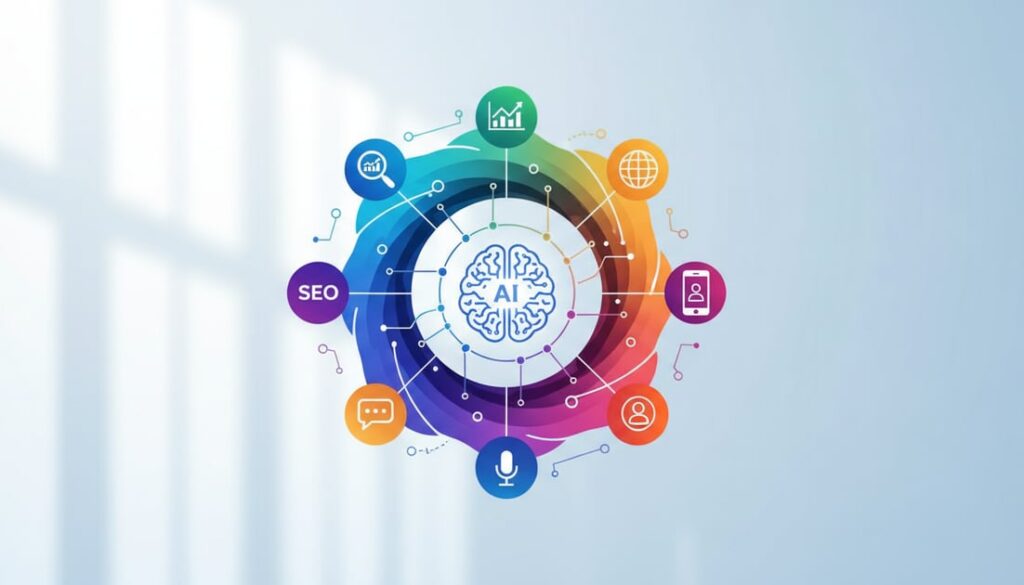
The holistic SEO approach unifies optimisation efforts across every search channel your audience uses – traditional engines, AI platforms, and emerging discovery systems – under a single, coherent strategy. Rather than managing Google SEO separately from ChatGPT optimisation or Perplexity visibility, this methodology treats all channels as interconnected components of one search ecosystem.
Unified tracking and measurement form the backbone. Instead of isolated analytics per platform, holistic SEO consolidates performance insights across traditional Search Engine Results Pages (SERPs) and AI-generated responses. You track your rankings alongside citation frequency in AI outputs, measuring total search visibility rather than channel-specific metrics. This reveals which content assets drive discoverability everywhere versus those succeeding in narrow contexts.
Contrast this with siloed approaches that fragment resources. Teams optimising separately for Google versus ChatGPT duplicate efforts, create conflicting content priorities, and miss cross-channel reinforcement opportunities. When your technical foundation strengthens traditional rankings whilst simultaneously improving AI crawlability, you've achieved strategic efficiency impossible under separated workflows.
The holistic SEO approach acknowledges that search behaviour spans platforms, but your brand presence shouldn't fragment with it. Integrated strategies amplify investment across channels – quality content, authoritative linking, structured data – delivering compounding returns rather than divided attention. This isn't about doing more work; it's about making every optimisation effort count across the complete search landscape.
Where UK Consumers Are Actually Searching in 2025
British consumers aren't choosing between traditional and Artificial Intelligence (AI) search – they're using both. Understanding this dual-channel behaviour reveals significant opportunities for UK businesses willing to embrace integrated SEO strategies.
The numbers demonstrate additive adoption rather than replacement. Google maintains commanding dominance whilst AI platforms experience rapid growth among UK users. Approximately 1 in 5 British consumers now regularly use AI search platforms for product research, yet traditional search engines remain the primary discovery channel for commercial queries. This parallel usage creates expanded visibility opportunities, not fragmented attention.
UK ecommerce data reinforces the multi-platform reality:
- Online retail represents 28% of total UK retail sales, with search driving the majority of product discovery
- Fashion and clothing dominate at 23% of ecommerce spend, followed by household goods and groceries
- AI-powered personalisation increases conversion rates by 15-20% when integrated across search touchpoints
The pattern is clear: consumers research on AI platforms, compare on traditional search, and purchase through multiple channels. A shopper might ask ChatGPT for gift recommendations, search Google for specific retailers, then complete the transaction via mobile. Each touchpoint requires optimised presence.
British businesses face a choice. Fragment your strategy across disconnected channels, or implement integrated SEO that captures visibility wherever your audience searches. The data shows UK consumers aren't limiting themselves to single platforms – your search strategy shouldn't either.
This dual-channel landscape rewards businesses treating traditional and AI search as complementary rather than competitive. When your content performs across both environments, you're positioned as Your Brand's Secret Digital Weapon – capturing demand regardless of where consumers begin their journey.
How to Integrate AI into SEO: Unified Tracking Framework
Integrating Artificial Intelligence (AI) into Search Engine Optimisation (SEO) demands measurement infrastructure that captures performance across traditional and AI-powered search simultaneously. Fragmented analytics – Google Search Console here, manual ChatGPT checks there – obscure the complete visibility picture your business needs.
A unified tracking framework consolidates these essential metrics:
- Traditional Key Performance Indicators (KPIs): organic rankings, click-through rates, conversion paths from Search Engine Results Pages (SERPs)
- AI-specific measurements: citation frequency across ChatGPT, Perplexity, and Claude; brand mention volume in AI responses; share of voice percentages
- Cross-channel attribution: which content assets drive discovery across both environments versus single-platform performance
UK enterprises typically implement comprehensive dashboards through SEO analytics projects costing £25,000+ initially, with £5,000+ monthly retainers supporting continuous monitoring. These solutions track citations daily across AI platforms serving over 1 billion monthly users, providing real-time visibility into brand presence beyond traditional search.
Small and medium enterprises face different constraints. Starting budgets from £1,000 monthly necessitate phased implementation – establishing baseline traditional metrics first, then layering AI citation monitoring as resources permit. Many UK SMEs begin with local search tracking before expanding to AI platform measurement.
The measurement gap represents strategic risk. Without consolidated performance insights, you're optimising blind – unable to identify which content formats succeed across platforms or where investment delivers maximum return. Platforms like SEMrush now provide integrated reporting that bridges traditional and AI search metrics, eliminating the manual aggregation that fragments visibility understanding.
Content Optimisation for Dual-Channel Performance
Creating content that succeeds across traditional search engines and Artificial Intelligence (AI) platforms requires structural precision, not duplication. The same foundational asset can perform everywhere when built with semantic clarity and question-based architecture.
Semantic structure forms the technical backbone. Organise content into topic clusters – comprehensive pillar pages addressing broad subjects, connected to detailed cluster pages covering specific subtopics. This architecture signals topical authority to Google's crawlers whilst simultaneously providing AI platforms the contextual depth needed for accurate citations. Schema markup amplifies this effect, with JSON-LD structured data helping both traditional algorithms and AI systems parse your content's meaning and relationships.
Question coverage addresses divergent query patterns. Traditional Search Engine Optimisation (SEO) targets transactional keywords; AI search responds to conversational, long-tail questions. Effective dual-channel content incorporates both – clear headings answering specific questions ("How does X work?") alongside keyword-optimised sections supporting traditional rankings. This approach captures voice search queries and AI platform requests without compromising Search Engine Results Page (SERP) performance.
Readability for machines and humans demands parallel optimisation:
- Clear hierarchical structure (H2, H3 tags) enabling both crawler navigation and AI content extraction
- Concise paragraphs with definitive statements AI platforms can confidently cite
- Multimodal elements – images, tables, lists – improving engagement whilst providing diverse data formats for AI processing
Topic clustering connects individual pages through descriptive internal linking, building semantic relationships that strengthen on-page SEO whilst helping AI platforms understand content scope. When pillar pages demonstrate comprehensive subject mastery, both traditional algorithms and AI systems recognise authority – delivering visibility across every platform your audience searches.
What Is the 80 20 Rule of SEO in an AI-First World?
The 80/20 rule in Search Engine Optimisation (SEO) applies the Pareto principle: approximately 20% of your optimisation activities generate 80% of search visibility outcomes. In an Artificial Intelligence (AI)-first landscape, this concentration intensifies – but the high-leverage 20% now spans both traditional and AI-powered platforms.
Research demonstrates that 20% of optimised pages typically drive 80% of organic traffic and conversions. The critical shift? Those same foundational pages now influence AI citation frequency across ChatGPT, Perplexity, and Claude. When you strengthen technical SEO foundations – structured data, semantic clarity, authoritative content – you simultaneously improve performance across every search channel.
Prioritise these high-impact integrated activities:
- Core technical infrastructure – Schema markup and site architecture benefiting traditional crawlers and AI content extraction
- Question-based pillar content – Comprehensive pages answering specific queries across both Search Engine Results Pages (SERPs) and conversational AI
- Authoritative topic clusters – Semantic relationships strengthening understanding core SEO whilst providing citation-worthy depth for AI platforms
UK businesses implementing this framework concentrate resources where returns compound. Rather than fragmenting efforts across disconnected tactics, the 80/20 approach identifies optimisation work that delivers visibility everywhere your audience searches – maximising efficiency whilst expanding reach across the complete search ecosystem.
The Business Case: ROI of Integrated Search Strategy
Revenue outcomes justify integrated search investment through conversion efficiency, not just volume. Recent analysis reveals AI-driven traffic converts at substantially higher rates despite lower absolute numbers – ChatGPT referrals generate sales-qualified leads at rates exceeding traditional organic by 3-4x in ecommerce contexts.
The trade-off reshapes strategic priorities. Traditional Search Engine Optimisation (SEO) delivers volume: thousands of monthly visitors through established rankings. AI platform citations drive fewer visits but capture high-intent audiences already deep in research phases. UK businesses optimising exclusively for Google capture broad awareness traffic; those ignoring AI platforms miss concentrated conversion opportunities.
The financial mathematics favour integration. Whilst AI Overviews reduced traditional click-through rates by 61% for affected queries, businesses maintaining presence across both channels offset volume losses with efficiency gains. A retailer losing 1,000 low-intent Google clicks but gaining 50 high-conversion AI referrals often sees revenue increase despite traffic decline.
UK enterprises implementing dual-channel strategies balance reach with precision – traditional search maintaining brand visibility whilst AI platforms capture ready-to-convert prospects. This isn't choosing between volume and efficiency; it's capturing both through coordinated investment across the complete search landscape.
Building Your Integrated SEO Roadmap
Effective integrated SEO implementation follows three distinct phases that accommodate resource constraints whilst building momentum across traditional and Artificial Intelligence (AI) search channels.
Immediate actions (Week 1-2) establish baseline measurement. Audit current Google Business Profile completeness, implement basic schema markup for location and business data, and configure tracking for both Search Engine Results Page (SERP) positions and AI platform citations. UK small businesses should prioritise mobile-first indexing compliance – Google's primary ranking factor – alongside structured data that AI platforms parse for citations.
90-day acceleration expands content reach. Develop question-based pillar pages addressing your audience's conversational queries, optimise existing high-performers with semantic enhancements, and build topic clusters linking related content. This phase balances quick wins – improving pages already ranking positions 4-10 – with foundational work that compounds across channels. Average click-through rate improvements of 15-25% emerge within this window when execution targets dual-channel performance.
Strategic expansion (6-12 months) scales visibility systematically. Establish monthly content calendars addressing seasonal query patterns, implement automated performance monitoring across traditional and AI platforms, and refine based on data-driven attribution insights. SEO Engico Ltd structures roadmaps around measurable milestones – citation frequency increases, organic growth percentages, conversion efficiency gains – ensuring accountability throughout implementation.
Customer behaviour demands this integrated approach. Your audience searches everywhere; fragmented optimisation leaves revenue opportunities unclaimed. Ready to build a roadmap capturing visibility across the complete search landscape? Your Brand's Secret Digital Weapon starts with strategic planning that addresses where consumers actually discover businesses in 2025.

