Best Ecommerce SEO Agencies for 2026

Priyanshu Bisht
SEO Executive

In a hurry? Summarise this with AI.
Open it in your AI tool of choice for the short version.
On this page
Picking an ecommerce SEO agency is harder than it should be. Search for one and you get a wall of near-identical pitches, every site promising more traffic, more revenue and a "proven process" you cannot actually inspect. The honest truth is that most agencies look the same on the homepage and behave very differently once the contract is signed. Some are genuinely good at the messy technical work that ecommerce demands. Others are content shops bolting product pages onto a blog template.
Ecommerce is its own discipline. You are dealing with thousands of product URLs, faceted filters that spawn near-infinite duplicates, seasonal demand swings and a category structure that has to serve shoppers and crawlers at once. A generalist who is great for a local plumber can drown in that. So this guide is built around what actually matters when you are selling products at scale, with an honest "best for" call on each agency so you can match one to your situation rather than the loudest sales page.
What actually separates a good ecommerce SEO agency from the rest
Almost everyone claims technical expertise, content quality and revenue focus. The difference shows up in how they handle the parts of ecommerce that quietly leak rankings and budget. Before you sign anything, look for evidence of these:
- Technical SEO that suits scale. Can they actually manage crawl budget and stop your filters generating thousands of thin, duplicated URLs? This is where most ecommerce sites bleed, and it is rarely fixed by writing more blog posts.
- Category and product page strategy. Category pages usually carry the commercial keywords. A good agency optimises them as landing pages, not afterthoughts, and knows when a product needs its own page versus a variant.
- Real authority building. Links and digital PR that pass relevance, not recycled directory spam that gets you a penalty two updates later.
- Revenue, not vanity metrics. Rankings and sessions are inputs. The agency should tie its work to qualified traffic, conversions and revenue, and show you the maths.
- Senior people on your account. Ask who does the work day to day. If the pitch comes from a director and the delivery goes to a junior, you will feel it in the results.
- Transparent reporting. You should always be able to see what was done, why, and what changed. No black boxes.
Hold every agency below to those standards. The fancy logos and award counts matter far less than whether they can do the unglamorous technical work and prove it moved the number that pays the bills.
The best ecommerce SEO agency options in 2026
Here are eight agencies worth your shortlist, starting with our own team and followed by strong competitors. Each comes with an honest note on who it suits best, because the right choice depends on your platform, your size and what you actually need fixed.
1. SEO Engico
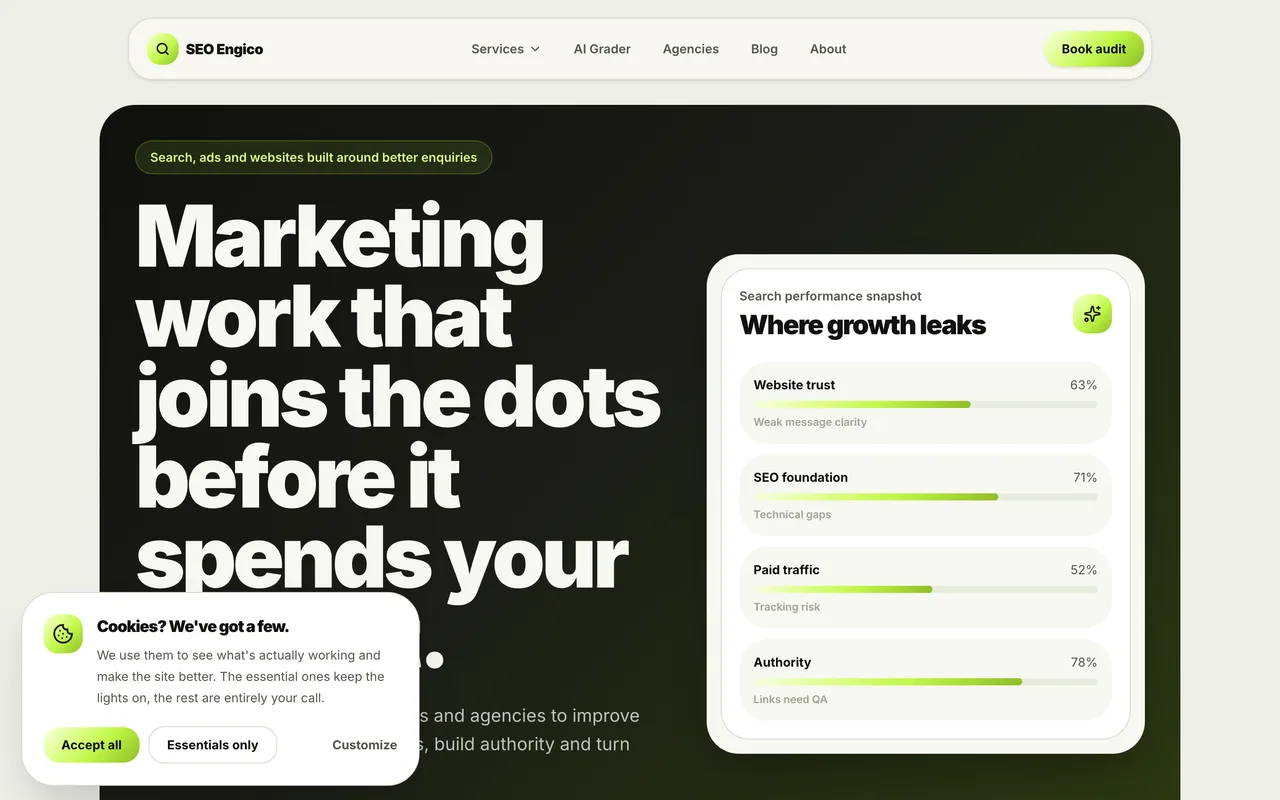
SEO Engico is run by mechanical engineers who treat marketing the way they once treated machines. Diagnose the system, find the bottleneck that is actually holding growth back, fix it, then measure whether the fix worked. For ecommerce that usually means starting with the boring, high-impact technical layer, because a store with crawl and indexing problems will not rank no matter how much content you publish on top.
The specialism is the part of ecommerce most agencies skip. Crawl budget on large catalogues, faceted navigation and pagination that quietly eat your crawl budget, product and category visibility, and increasingly whether your products show up in AI Overviews on shopping queries now that those are rising fast. The team pairs that technical foundation with ecommerce SEO that is judged on qualified leads and revenue, not a screenshot of a ranking. Authority work runs through white-hat link building, real placements with relevance behind them rather than volume for its own sake.
It is senior-led and independent. No juniors learning on your account, no work quietly outsourced to a link farm. Reporting is transparent, so you can see exactly what was done and what it changed. The team is white-label capable and serves the UK, US and Australia.
Best for: ecommerce brands that suspect a technical bottleneck is capping growth and want senior people who will prove the fix worked in revenue, not rankings.
2. Re:signal
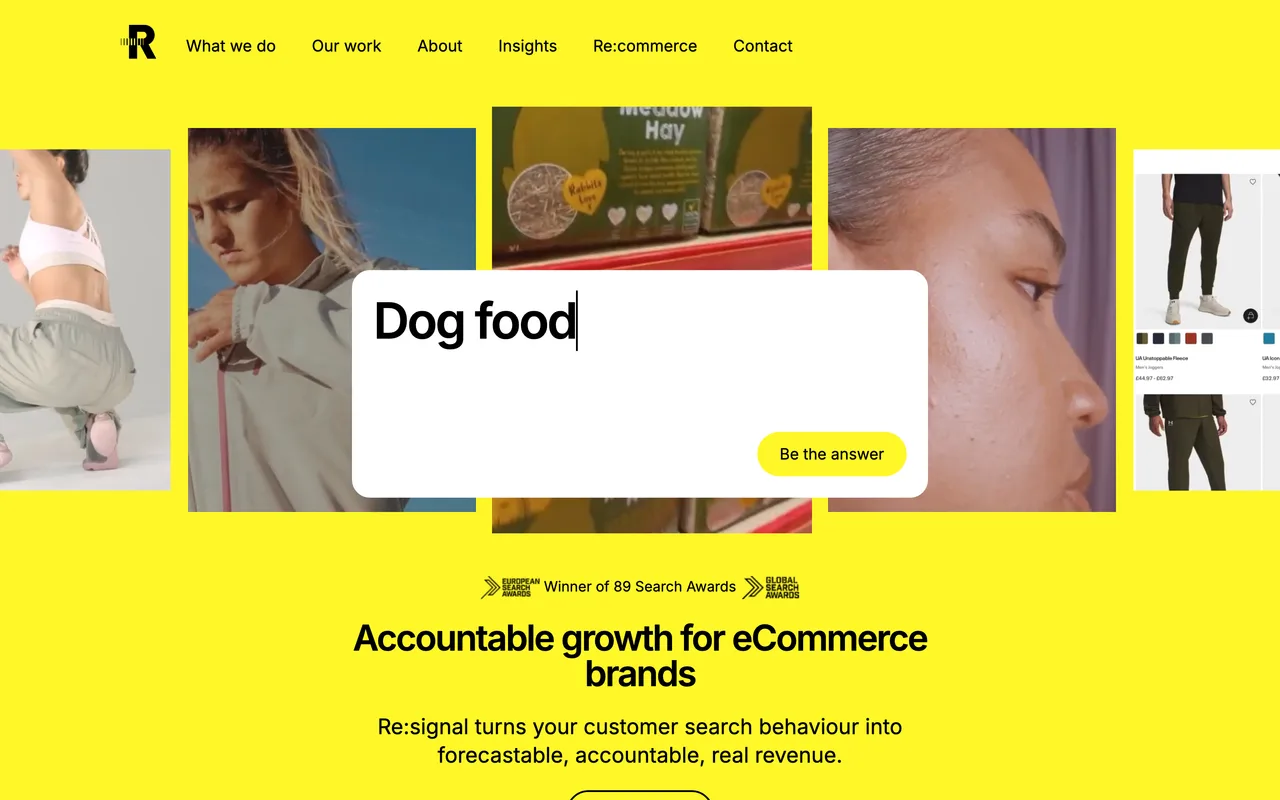
Re:signal is a remote organic growth agency built specifically for ecommerce brands. Its remit stretches across traditional, retail, AI and social search, which is a sensible spread now that shoppers start product research in more places than just Google. The agency states it has won 89 Search Awards across European and Global ceremonies, so its work is clearly recognised in the industry.
The positioning leans hard on accountability and revenue, which is the right instinct for ecommerce where the only metric that matters is sales. If you want an organic partner that thinks in commercial outcomes rather than ranking reports, they fit that brief.
Best for: established ecommerce brands that want an accountable, revenue-focused organic search programme.
3. Eastside Co
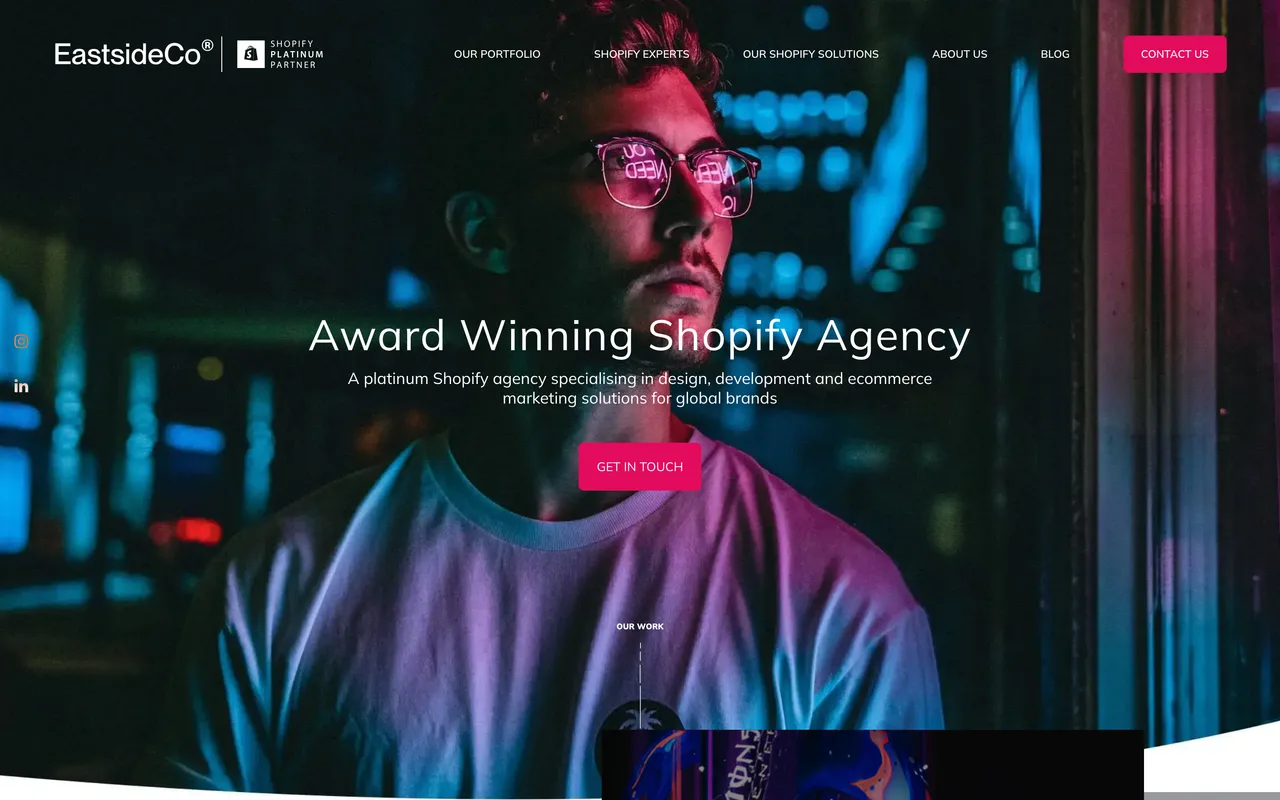
Eastside Co is a Shopify Platinum Partner with offices in London, New York and Dubai. It covers web design, migrations and ecommerce marketing including SEO and PPC, and the site states the team has built over 500 Shopify stores. That depth on one platform is genuinely useful, because Shopify has its own quirks around URL structure, collections and apps that affect SEO.
The advantage here is having build and growth under one roof. If your store needs design or development work alongside the search strategy, you are not stitching two agencies together and hoping they agree.
Best for: Shopify and Shopify Plus merchants who need combined build and growth support from one team.
4. Genie Goals
Genie Goals is an award-winning ecommerce performance marketing agency based in Cambridge and part of the Genie Ventures Group. Its strengths sit in paid: paid search, paid social, affiliates and influencer marketing, with strategy wrapped around it. SEO buyers should know the centre of gravity is acquisition through paid channels.
That said, paid and organic work better together than apart, especially on ecommerce where you want to defend high-value terms across both. If your growth plan leans on paid acquisition with organic playing a supporting role, this is a sensible home for it.
Best for: ecommerce brands focused on paid acquisition alongside organic growth.
5. Inflow
Inflow, founded in 2007 and based in Denver, specialises in ecommerce and lead generation. It offers SEO, PPC, paid social, CRO and email marketing, and holds Google Premier Partner, Microsoft and Meta partner status. That full-funnel mix means traffic does not just land on your site, it gets optimised on the way to checkout too.
The CRO and email layers are worth flagging. Plenty of ecommerce SEO programmes win the traffic battle and lose the conversion war. An agency that handles both can close that gap rather than hand it off.
Best for: ecommerce and lead-gen businesses that want full-funnel SEO plus paid media under one roof.
6. Absolute Web
Absolute Web, founded in 1999 and based in Miami, is a digital commerce agency with a team the site states is over 85 experts. It works across Shopify Plus, Adobe Commerce, BigCommerce and WooCommerce, covering custom development, ecommerce strategy, CRO, SEO and paid media. The platform breadth is unusual and useful if you are not on Shopify.
This is a strong option when SEO is part of a bigger build conversation. Replatforming is one of the riskiest moments for organic visibility, and having the same agency handle the migration and the search strategy reduces the chance of tanking rankings in the move.
Best for: brands that need ecommerce build or replatforming alongside SEO and marketing.
7. Victorious
Victorious is a full-service SEO agency covering on-page, off-page and technical SEO, plus answer engine optimisation, content and link building. The site states it has served 600+ brands across sectors including ecommerce. The clear focus on AI visibility is timely, since more product research now starts inside AI answers than it did a year ago.
Because the work spans multiple sectors rather than ecommerce alone, the value is a broad SEO toolkit applied to your store. If you want a results-led partner that takes AI search seriously and is not tied to one platform, they are worth a conversation.
Best for: ecommerce and multi-sector brands that want a results-led SEO partner with an AI visibility focus.
8. NOVOS
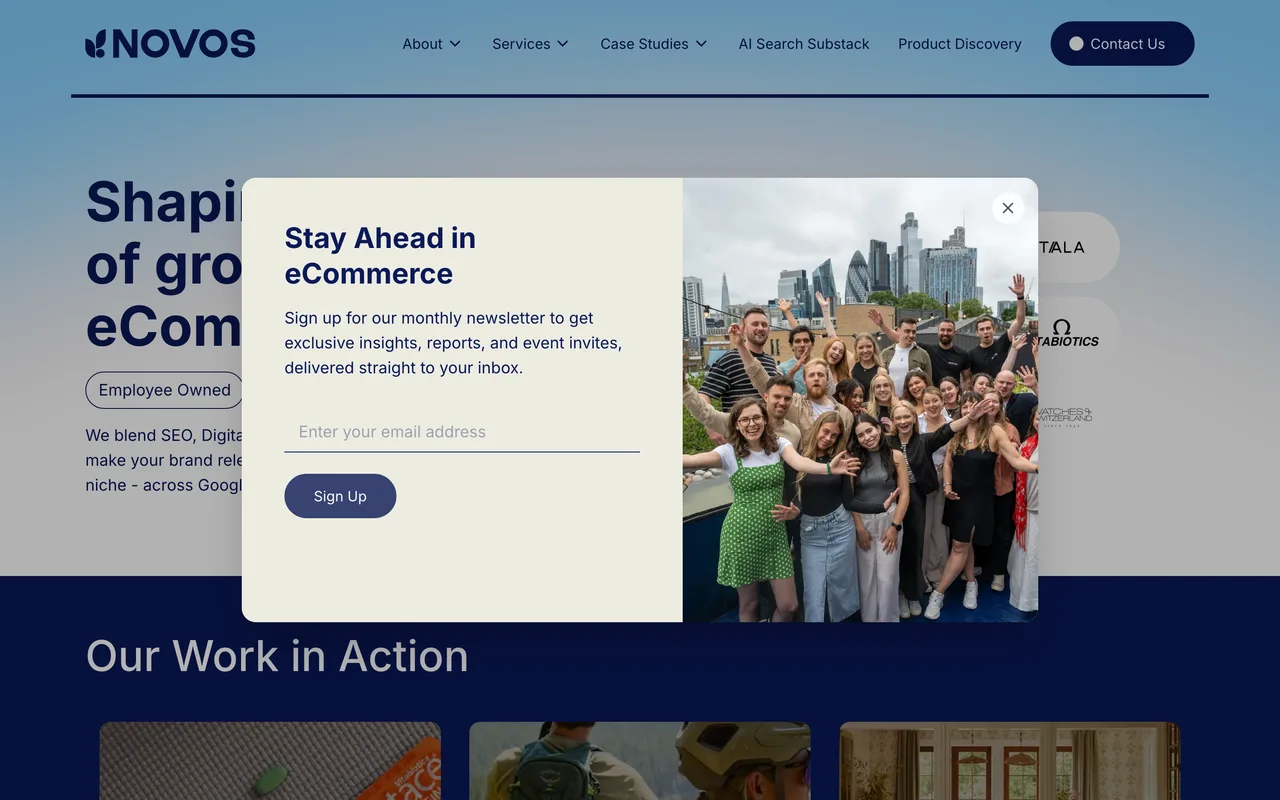
NOVOS is an employee-owned London agency focused on organic growth for ecommerce brands. It blends SEO, Digital PR, paid media and AI search optimisation. The agency launched in 2018 as statement.digital before rebranding to NOVOS. The Digital PR angle is a real differentiator, since that is one of the cleaner ways to earn the kind of authority ecommerce sites struggle to build.
Employee ownership tends to mean people stick around, which matters when SEO is a long game and you do not want a new account manager every quarter. For a specialist organic partner with a strong PR muscle, they are a credible pick.
Best for: ecommerce brands that want a specialist SEO and Digital PR partner.
How to choose the right ecommerce SEO agency for you
Start with what is actually broken. If your traffic is fine but sales are flat, you may need CRO more than SEO. If you have great content but products that never rank, the problem is almost certainly technical: crawl budget, indexing or a category structure search engines cannot make sense of. Naming the bottleneck first stops you buying the wrong service.
Then match the agency to your platform and your stage. A Shopify Plus merchant mid-replatform has different needs to an Adobe Commerce store with a clean build and a ranking problem. Some of the agencies above are build-led, some are paid-led, some are pure organic. None of those is wrong, they are just suited to different jobs.
Ask three blunt questions in the sales call. Who will actually do the work, day to day? How do you handle faceted navigation and crawl budget on a large catalogue? And how do you report on revenue rather than rankings? The answers separate the operators from the order-takers fast. Finally, be honest about timelines. Ecommerce SEO compounds over months, not weeks, and any agency promising overnight results is selling you something other than SEO.
Frequently asked questions
How long does ecommerce SEO take to show results?
Usually three to six months before you see meaningful movement, and the bigger commercial gains tend to land between six and twelve. Technical fixes can move things faster, since clearing a crawl or indexing block can recover visibility quickly. Content and authority building compound more slowly. Anyone promising rankings in a few weeks is either lucky or not telling you the whole story.
Should I hire an agency or build an in-house ecommerce SEO team?
In-house gives you focus and product knowledge, but a single hire rarely covers technical SEO, content and authority building well, and hiring across all three is expensive. An agency brings that range and a wider view of what works across many stores. Plenty of brands run a hybrid: an in-house lead who owns strategy, with an agency handling execution and the heavier technical work.
Can an agency do white-label SEO for my own clients?
Yes. White-label SEO lets another business deliver search work under your brand, which is common for web design studios and marketing agencies that do not have SEO specialists in-house. The work ships under your name, your client never sees the supplier. SEO Engico is white-label capable if that is how you want to operate.
How much does an ecommerce SEO agency cost?
It scales with the size of your catalogue, how competitive your market is, and the authority and relevance of what gets delivered. A small store in a quiet niche needs far less than a large catalogue fighting national competitors. The cheapest quote is rarely the best value, because thin work and spammy links can cost you more to clean up later than they ever earned. Judge it on outcomes and the calibre of what is actually delivered, not the headline number.
Where to go from here
Any of these agencies can do good work for the right store. The trick is matching the agency to your real problem rather than the shiniest pitch. If you think a technical bottleneck is capping your growth and you want senior people who will prove the fix in revenue, our ecommerce SEO team is built for exactly that. The fastest way to find out is to book a search performance audit and see what is actually holding your store back.