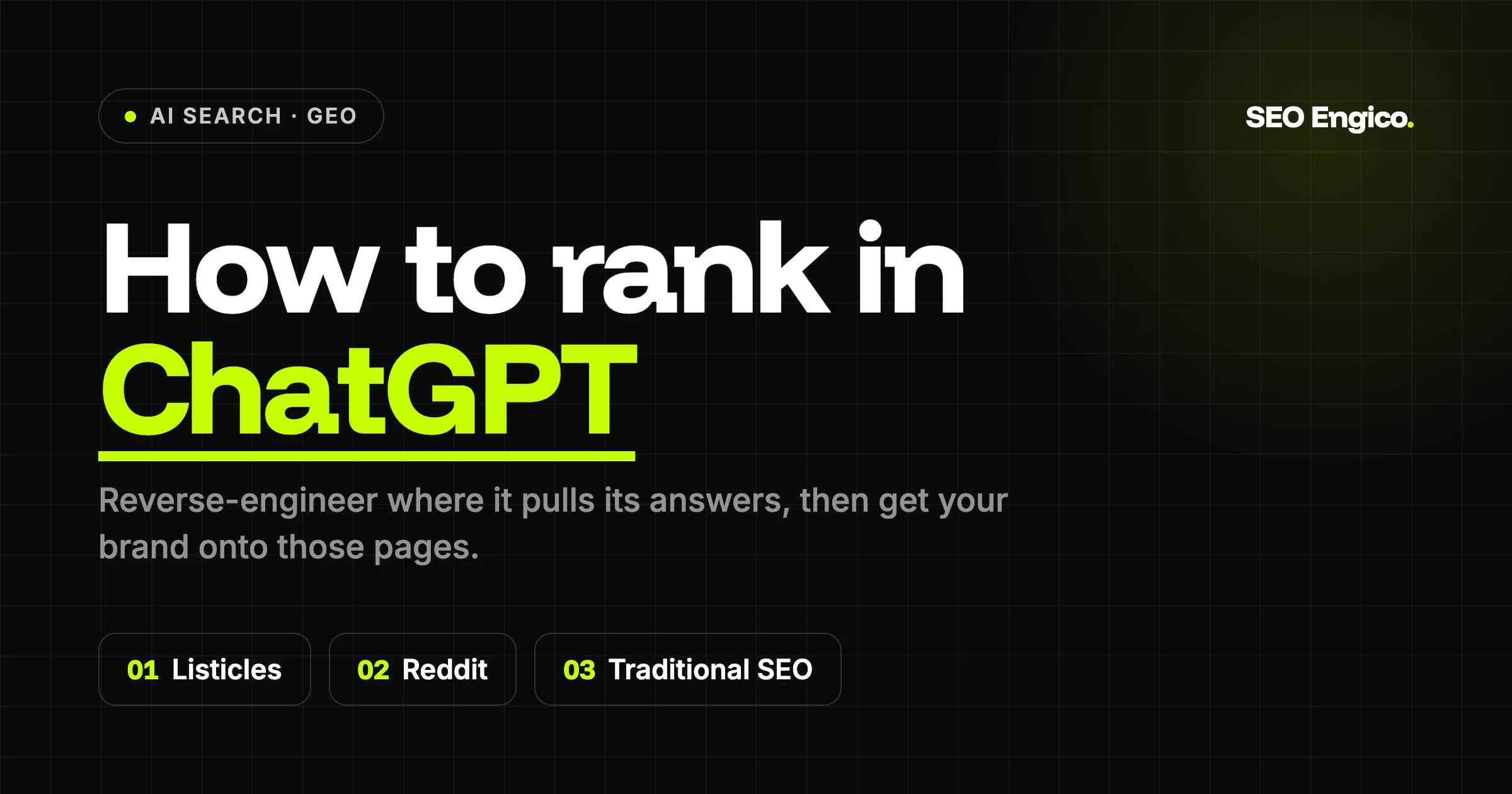
How to Rank in ChatGPT: Reverse-Engineering Where It Pulls Its Answers

Jhonty Barreto
Founder
In a hurry? Summarise this with AI.
Open it in your AI tool of choice for the short version.
On this page
Ask ChatGPT "who is the best plumber in Leeds" or "best SEO agency for SaaS" and it will name a handful of businesses without hesitating. For the companies it names, that is free, high-trust demand landing in front of someone who is ready to buy. ChatGPT's outbound referral traffic grew 206% year over year into 2026, and for a lot of buyers it is now the first place they go to build a shortlist.
The frustrating part is there is no Search Console for ChatGPT. No ranking report, no impressions tab, no clear "you are position three" signal. So most owners assume it is a black box and move on. It is not. You can reverse-engineer where ChatGPT gets its answers, and once you can see the sources, you can work your way onto them. This guide breaks down the three levers that actually move it: the listicles it reads, Reddit, and plain old SEO. Then it pulls them into a short playbook you can run today.
First, understand what ChatGPT is actually reading
ChatGPT Search launched at the end of October 2024, and it does not invent recommendations out of thin air. It pulls from a mix of its training data, a live web index it builds with its own crawlers (OAI-SearchBot, GPTBot and ChatGPT-User), and third-party search results including Bing.
That matters because it reframes the whole problem. "Ranking in ChatGPT" is not some mysterious new skill. It is the practice of getting your brand onto the web pages ChatGPT trusts enough to read and repeat. Find those pages, get listed on them, and you show up. That is the entire game, and the next three sections are how you play it.
Lever 1: Reverse-engineer the listicles it reads
When a question carries buying intent (best, top, recommended, alternatives to), ChatGPT leans heavily on third-party roundups rather than anyone's homepage. The data is blunt about it. In an analysis of 43,000 AI citations, listicles made up 47% of citations for commercial queries, while a brand's own site barely featured. For branded questions specifically, around 77% of citations came from off-site sources, not the company website.
Translation: the "best [your service]" articles are the ranking factors. If you are not on the lists ChatGPT reads, you stay invisible no matter how good your own website is.
Here is the reverse-engineering move, and it takes about half an hour:
- Write down the 10 to 20 questions a real buyer would ask before choosing you. "Best [service] in [city]", "[competitor] alternatives", "who should I hire for X".
- Ask ChatGPT each one with search turned on so it cites sources. Click through and note every brand it names and every URL it pulls from.
- Watch for the pages that show up again and again. Those repeat sources are your target list. They are quite literally the articles deciding who gets recommended in your category.
Now you have a shortlist of the exact pages that influence your space. Getting onto them is normal outreach and PR: pitch the author for inclusion, offer a better stat or quote, get added to the roundup, or build and earn links to a stronger comparison piece of your own. Unglamorous, but it is the lever that moves.
Lever 2: Get named in Reddit threads
Reddit is not just one source among many. Across 9.6 million ChatGPT queries, Reddit was the single most-cited domain, ahead of Wikipedia and everything else. There is a reason for that. OpenAI signed a data partnership with Reddit in May 2024 that gives it licensed, real-time access to Reddit content. When real people argue about "what is the best X" in a thread, that consensus is exactly the kind of signal ChatGPT repeats back.
So the play is to be genuinely present in the threads where your buyers hang out. Answer the "can anyone recommend a..." questions honestly. Earn authentic mentions from real users. Make sure your brand name turns up in the discussions, reviews and comparisons people are already having without you.
One firm warning. Reddit is ruthless about self-promotion, and a thread full of obvious shilling gets removed, buried in downvotes, or turned against you. Do it for real or do not do it at all. Authentic beats volume every single time.
Lever 3: Traditional SEO is still upstream of all of it
Here is the part the "SEO is dead" crowd keeps getting wrong. The pages ChatGPT reads, the listicles and the Reddit threads and the review sites, are overwhelmingly pages that already rank and already carry authority. AI search sits on top of the open web, not instead of it.
It is not a one-to-one mapping. Only about 38% of pages cited in Google's AI Overviews also rank in the top 10, down from roughly 76% a year earlier, so a top ranking does not guarantee a citation. But the strongest classic signal for AI visibility is not even your own rankings, it is how often your brand is mentioned across the web, a far stronger correlation than raw backlinks on their own.
Read those two facts together and the strategy writes itself. You want the foundations of real SEO, which is content that ranks for your category terms, a healthy link profile and clean topical authority, plus brand mentions scattered everywhere that matters. Strong white-label link building and digital PR are what get your name onto the third-party pages in the first place, which is why link building and AI visibility are now the same project, not two separate ones.
The short guide: rank in ChatGPT in 6 steps
Pulling all three levers together, here is the whole playbook on one page:
- Map the buying prompts. List the 10 to 20 questions a customer would ask ChatGPT before hiring or buying in your category.
- Run them and log the sources. Ask each prompt with search on, record every brand named and every page cited. The repeat URLs are your target list.
- Get onto those listicles. Pitch the authors, earn inclusion, or build and promote a stronger comparison page that out-earns theirs.
- Build a real Reddit and community footprint. Get genuinely mentioned in the threads buyers read. No spam, real participation.
- Shore up the SEO underneath. Rank for your category terms, earn links, and push brand mentions across the web so the pages ChatGPT reads already include you.
- Re-run the prompts monthly. ChatGPT's sources shift constantly. Track which brands and pages it names over time and double down on what is moving.
TL;DR
ChatGPT recommends businesses to buyers, and you can reverse-engineer how. Ask it the buying questions your customers ask and note the listicles and Reddit threads it cites, because those third-party pages, not your homepage, decide who gets named. Get onto them through outreach, genuine community presence and the brand mentions that good link building creates. And do not ditch traditional SEO, because every source ChatGPT trusts is a page that earned its authority the old-fashioned way. Pull all three levers, then re-check monthly.
FAQs
Can you actually optimise for ChatGPT?
Not directly the way you tune a Google page, because there is no ranking dashboard. You influence it indirectly, by getting your brand onto the third-party pages ChatGPT reads, mainly buying-intent listicles, Reddit threads and authoritative articles, and by strengthening the SEO and brand mentions underneath them.
Why does ChatGPT cite Reddit so much?
Two reasons. OpenAI has a licensing deal for real-time Reddit data signed in 2024, and Reddit threads contain exactly the kind of honest "what is best for X" consensus that language models like to summarise. In one study of millions of queries, Reddit was the most-cited domain in ChatGPT.
Does traditional SEO still matter for AI search?
Yes, more than the headlines suggest. The pages AI tools cite are usually pages that already rank and already have authority, and brand mentions across the web are one of the strongest signals for AI visibility. SEO and link building are upstream of getting recommended, not separate from it.
How long does it take to show up in ChatGPT?
It depends on how visible your brand already is on third-party pages. Fresh mentions and links can start influencing answers within weeks, but building enough presence across listicles, Reddit and ranking pages to be recommended consistently is a few-months project, not an overnight switch.
Want us to do it for you?
Getting onto the pages ChatGPT trusts is, underneath the AI label, a link building and digital PR job. That is exactly what we do. If you want your business showing up when buyers ask ChatGPT for a recommendation, tell us what you are working on and we will map the prompts and the pages for your category.