In a hurry? Summarise this with AI.
Open it in your AI tool of choice for the short version.
On this page
- What this plan covers, and what it leaves out
- Why Google alone leaves a gap
- Days 1 to 14: find out where you stand
- Days 15 to 30: fix what you already have
- Days 31 to 60: build the pages people hire from
- Days 61 to 90: get onto the lists ChatGPT checks
- Measure what pays you
- The 90-day plan on one page
- What 90 days can and can't do
- Frequently asked questions
- Do one thing this week
- Sources
On November 3, 2026, we searched "car accident lawyer" from New York. Google's first page had 10 law firms on it. Then we asked ChatGPT, with web search on, who the best car accident lawyer in New York City is. It named lawyers at two firms, and only one of those firms was on that first page.
So a firm can win on Google and still go unmentioned when a client asks AI. This is the 90-day plan we'd run to close that gap: what to do in the first two weeks, then in months one, two and three, and how to tell whether it's paying. Personal injury is the worked example because that's where we've run our tests, but the steps work for any practice area.
The video covers the whole plan in ten minutes. Jump straight to a part:
- 0:00 10 firms on page 1, ChatGPT named 1
- 0:41 Why the pipeline leaks
- 2:31 Days 1 to 14: find out where you stand
- 3:53 Days 15 to 30: fix what you already have
- 4:58 Days 31 to 60: build the pages people hire from
- 7:09 Days 61 to 90: get onto the lists ChatGPT checks
- 8:17 Measure what pays you
- 9:23 Do this one thing this week
What this plan covers, and what it leaves out
A marketing plan needs a goal, a budget and a way to measure it, so here are ours.
The goal is more signed cases of the types you want, in the cities you serve, from search. Not more traffic. Those are different things, and the gap between them is bigger than most firms think.
The budget is mostly time: someone to pull your search data, an attorney who can review a page within a week, and a writer for the pages you build in month two. There's no ad spend in this plan.
That's deliberate. Google Ads, referrals and past clients still matter, and this plan doesn't replace any of them. But across the 11 personal injury firms we studied, the searches they win cost a median of $163 a click on Google Ads, with a range of $71 to $237. Every one of those clicks you earn by ranking is one you don't have to buy.
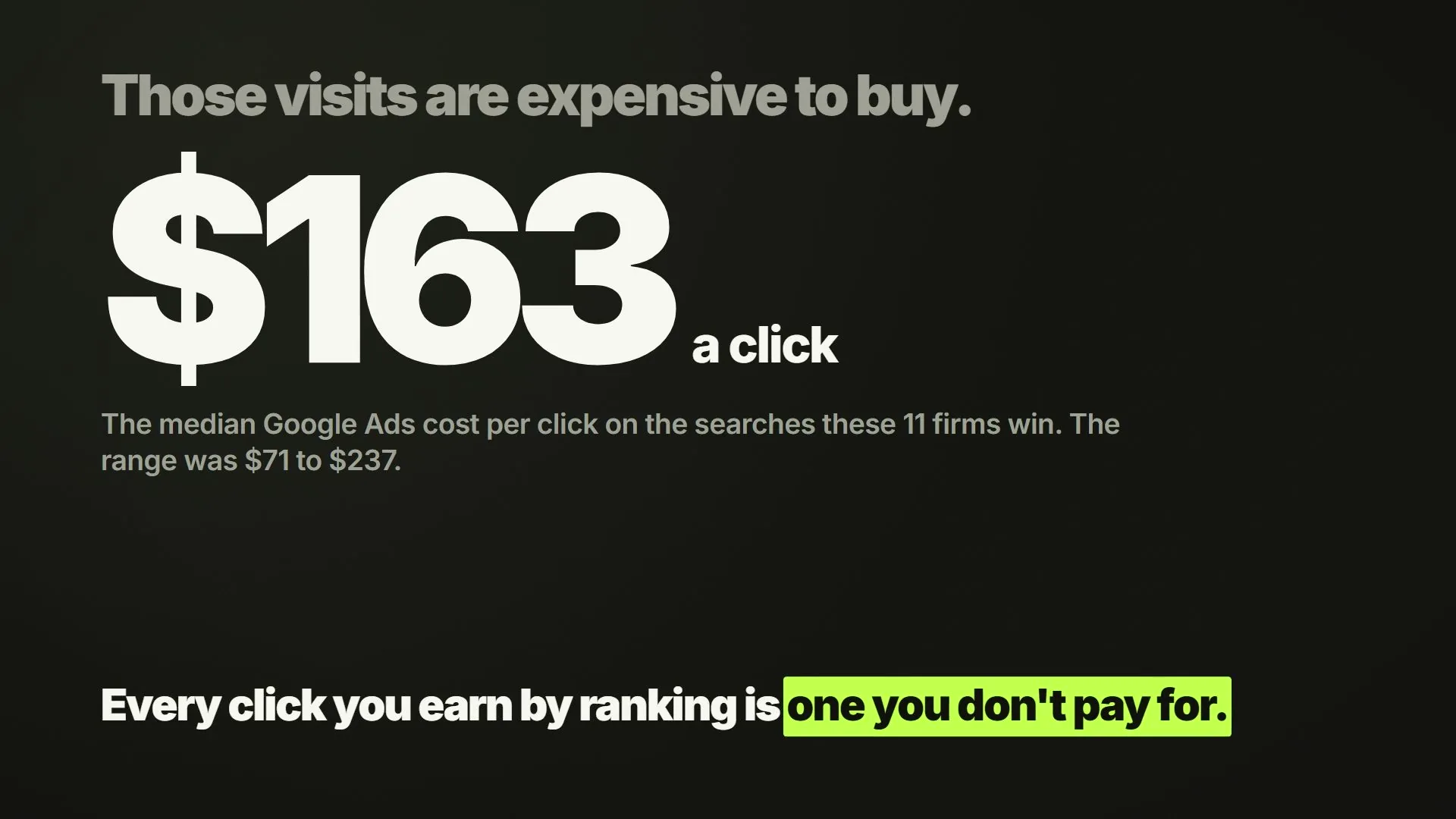
Median cost per click on the hire-intent searches 11 personal injury firms rank for, in 8 US cities. DataForSEO estimates, October 29, 2026.
Why Google alone leaves a gap
People find a lawyer in two places now. They search Google, or they ask an AI like ChatGPT. The two don't pick the same firms, because they don't look at the same things.
What ChatGPT checked before it named anyone
Before ChatGPT answered our New York question, it ran five searches of its own:
- A ranked list of the best personal injury lawyers for 2026
- The state's attorney registration and discipline records
- One lawyer's bio page on their firm's website
- The New York City Bar's legal referral service
- The New York courts' attorney search
That's how a careful client checks a lawyer. Only one of the five searches touched a law firm's website, and it went to an attorney's bio page, not the homepage.
The answer cited a single source: Doyle's Guide's 2026 New York rankings, a peer-reviewed list that says its rankings "cannot be purchased." All three lawyers ChatGPT named are on it.
98 sources, and 12 were law firm websites
One answer could be a fluke. So the week before, we asked the same kind of question 32 times: "Who is the best personal injury lawyer in [city]?", eight times each in Los Angeles, Houston, Philadelphia and Atlanta, using ChatGPT with web search. Across those 32 answers it cited 98 sources.
| Source type | Citations | Share |
|---|---|---|
| Legal rankings and best-of lists (Chambers, Best Lawyers, Super Lawyers, Doyle's Guide and others) | 62 | 63.3% |
| Bar, court and lawyer referral sites | 21 | 21.4% |
| Law firm websites | 12 | 12.2% |
| Trial lawyer groups and other | 3 | 3.1% |
One ranking stood out. Chambers was cited 33 times and showed up in 20 of the 32 answers, including all eight in Los Angeles. ChatGPT also ran 75 searches behind those answers: 37 named a ranking, and 25 checked bar records, board certification, referral services or discipline history.
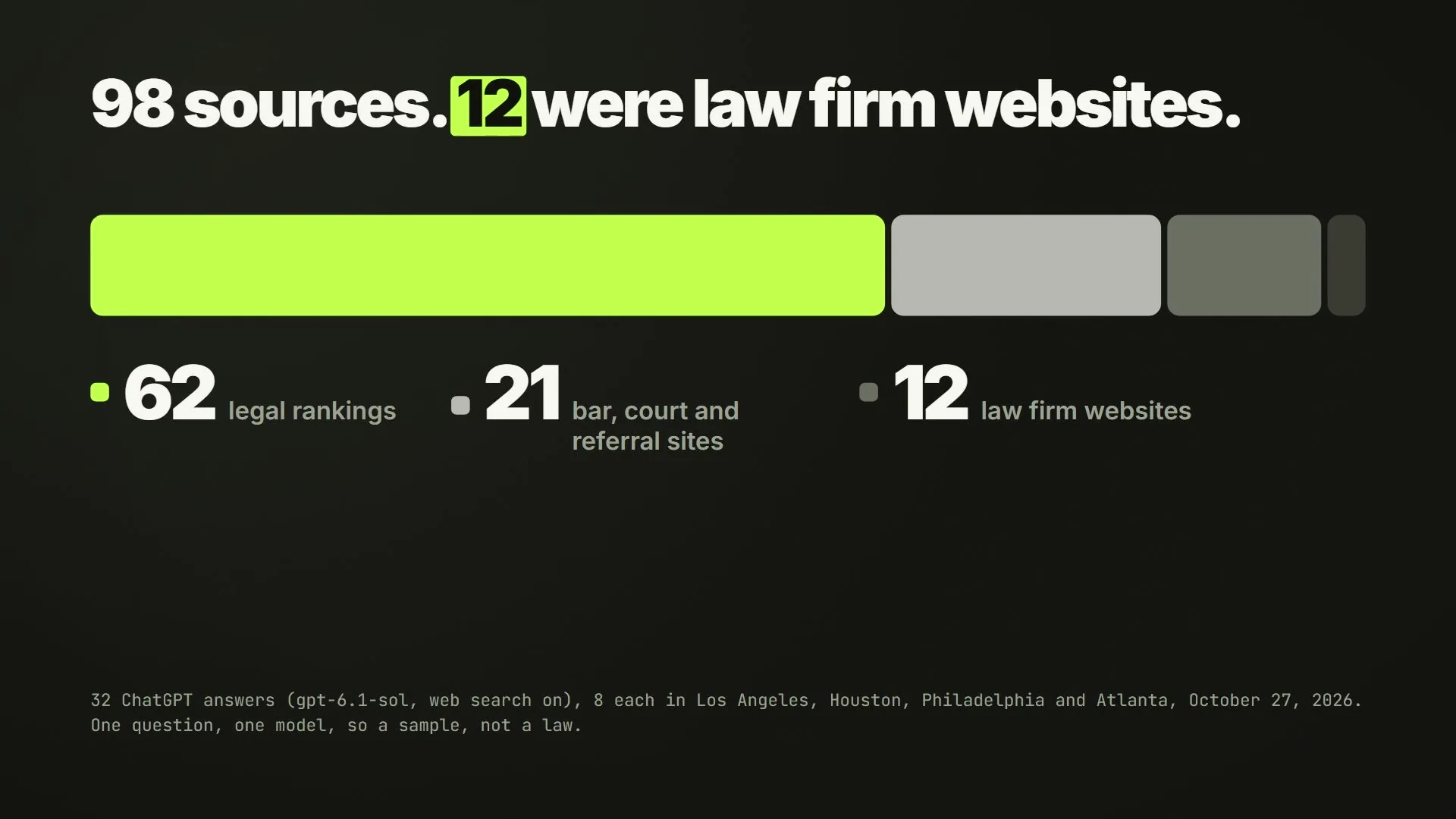
32 ChatGPT answers with web search, 8 each in Los Angeles, Houston, Philadelphia and Atlanta, October 27, 2026.
If you run a personal injury firm, the rankings you're on are doing more of the talking in ChatGPT than your homepage is.
On Google, the problem is which traffic you win
Google has its own trap. We pulled search data for 11 personal injury firms that rank in eight big US cities. One New Jersey and Pennsylvania firm gets about 108,000 visits a month from Google, and only about 5,000 of them are people looking for a lawyer. The rest are researching: how long they have to file, what a claim might be worth, what to do after a crash.
Wilshire Law Firm in Los Angeles gets fewer visits, about 89,000. But roughly 79,000 of those are people looking for a lawyer.
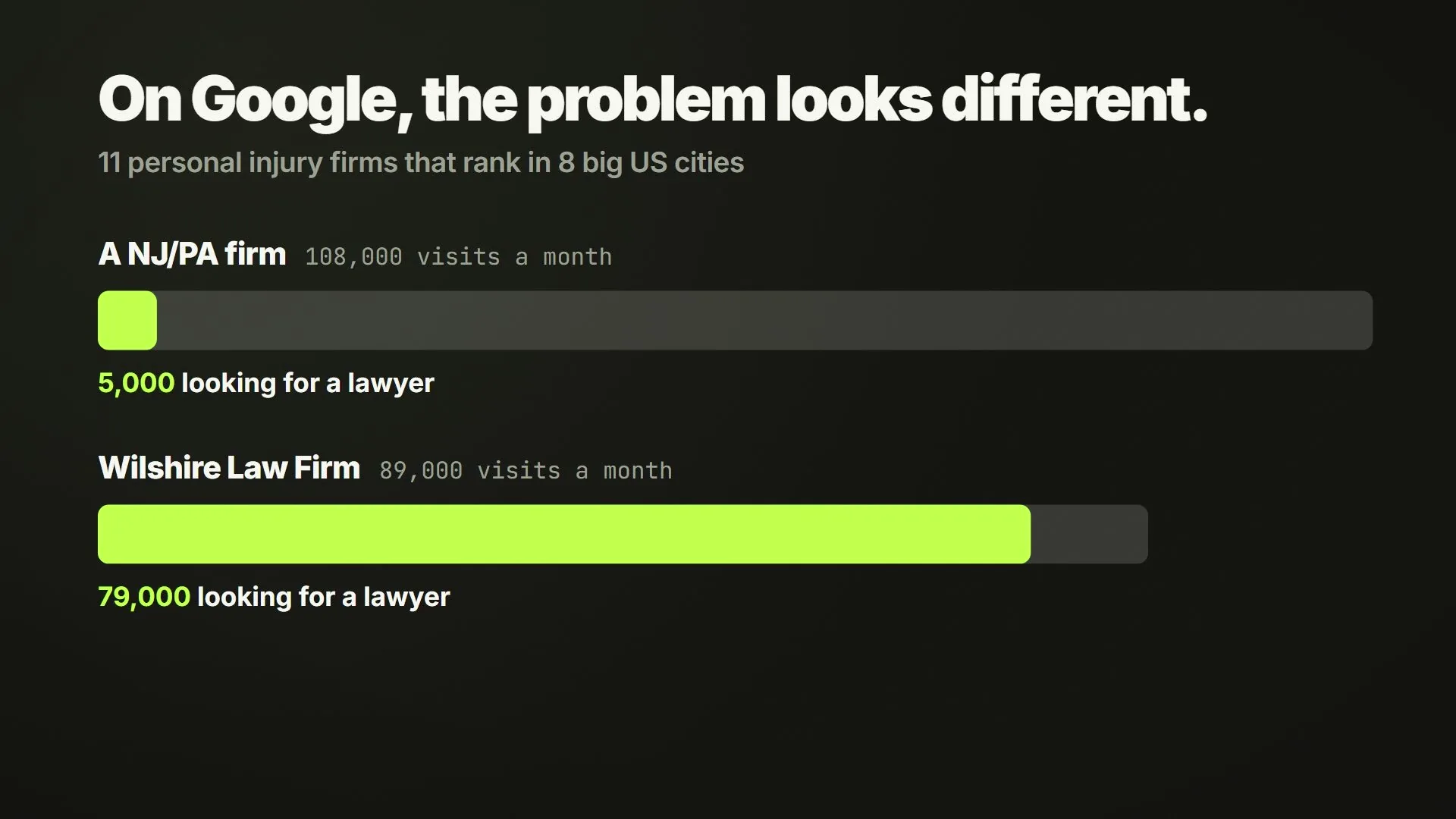
Estimated monthly Google visits, split by whether the search was for a lawyer. DataForSEO, October 29, 2026.
Total traffic is a vanity number. The visits that count are the ones that can hire you. Research traffic is also where AI answers sit: for the typical firm we studied, 77.1% of its research traffic came from searches that show an AI Overview, against 16.6% of its hire-intent traffic.
So the plan has two halves. The Google half is pages and a map listing for the searches that hire. The AI half is the lists and records ChatGPT checks before it names anyone. Here's how we'd spend the 90 days.
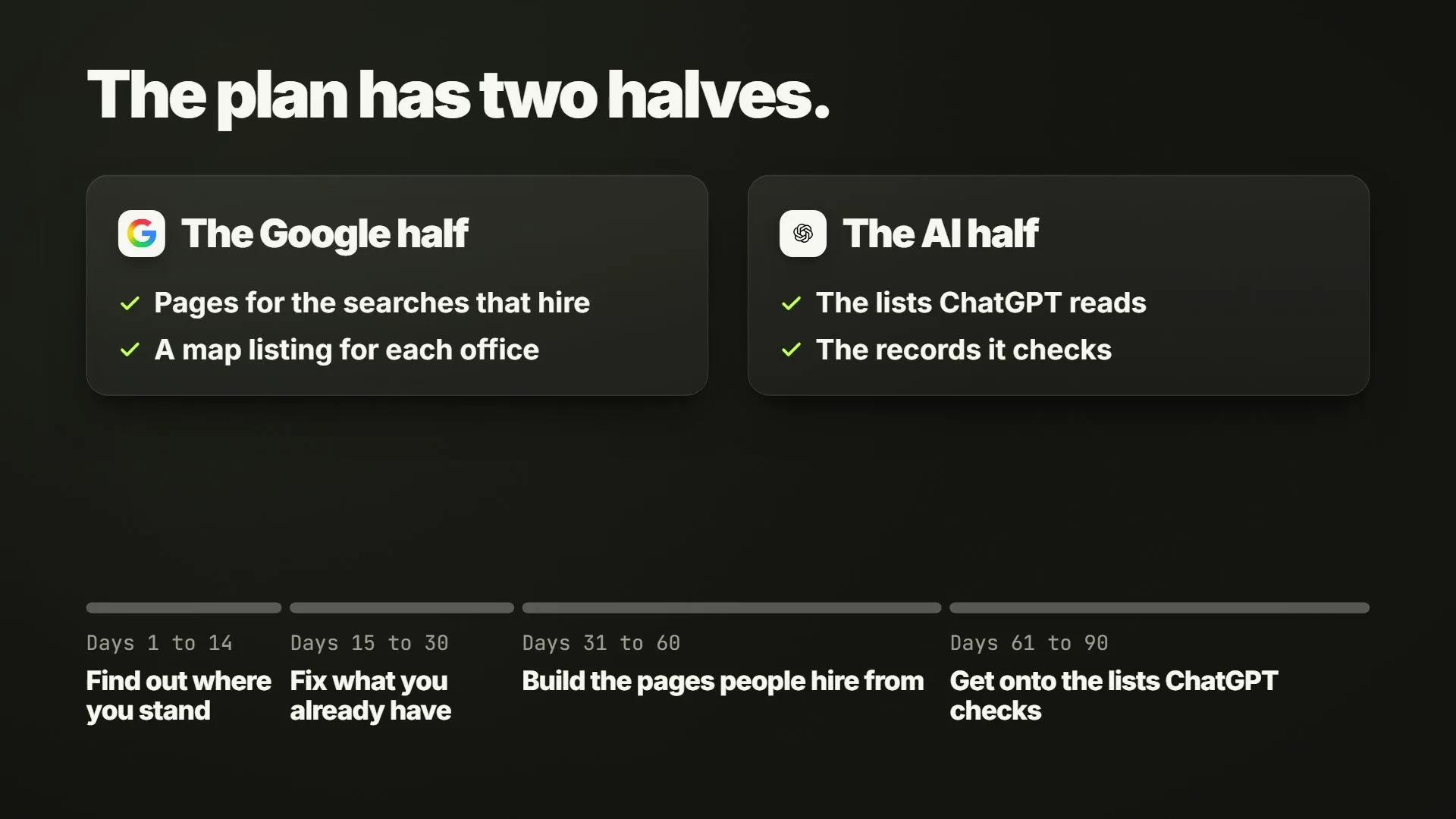
Days 1 to 14: find out where you stand
Don't spend a dollar on content or links until this is done. Two weeks of looking saves months of building the wrong pages.
- Split your Google traffic three ways. People searching for a lawyer ("car accident lawyer brooklyn"), people researching ("how long do I have to file an injury claim in new york"), and people searching your firm's name. A Search Console export of your queries is enough to start, and a few hundred rows can be tagged by hand.
- See where the lawyer searches land. City pages, case type pages, the homepage, or blog posts. If most of your hire-intent traffic lands on blog posts, the pages people hire from are probably missing.
- List every case type and every city you take. Tick the ones that have their own page. The gaps are your build list for month two.
- Check the map pack for your three most important searches, from each city you serve. For the typical firm we studied, 73% of the traffic that didn't use its name came from searches that also showed the map. Check from the city itself, with a rank tracker set to that location or someone local, because the map pack changes from one neighborhood to the next.
- Ask ChatGPT, ten times. "Who is the best [case type] lawyer in [your city]?" Use a temporary chat with search on, so your own history doesn't shape the answer. Write down who it names, and every source it cites.
Then look up each of those sources and how it picks lawyers. Some only take submissions once a year, so note the deadlines now.
By day 14 you should have two lists: the pages you're missing, and the sources you're missing from.
Days 15 to 30: fix what you already have
This is the quickest work, because it touches searches you already show up for.
A Google Business Profile for each office
For the typical firm in our study, 73% of the traffic that didn't use its name came from searches that also showed the map pack. That makes the Business Profile one of the hardest-working pages you have. Set the primary category to the practice you most want more of, such as Personal injury attorney rather than plain Lawyer, list every case type you take as a service, and keep the hours and photos current. Three offices means three profiles, each one checked against Google's guidelines for business profiles.
Attorney bio pages that match the bar
In New York, ChatGPT read one lawyer's bio page and checked the court's registration records in the same answer. So the two should agree. Every lawyer at the firm needs a page with:
- Their full name, exactly as registered
- Their bar admissions, with the state and the year
- The case types they handle
- Links to any rankings they're on
Reviews, every week
Ask every client whose case closed well to leave a review on your Google profile, and ask every week. Never buy reviews and never write them. The FTC's rule on consumer reviews and testimonials, adopted in 2024, bans fake and bought reviews.
The searches already on page two
In Search Console, filter your hire-intent searches for an average position between 11 and 20. Those pages are closer to page one than anything you haven't built yet. Tighten the title and main heading around the case type and city, answer the questions your intake team hears, and link to the page from your homepage and practice area pages.
Days 31 to 60: build the pages people hire from
Start with the gaps on your list from week one. Here's where the winners in our study get most of their Google traffic:
| Firm | Where the traffic lands | Share of Google traffic |
|---|---|---|
| Morgan & Morgan | Case type pages | 77% |
| Ben Crump Law | City pages | 55% |
| Gallardo Law Firm | Spanish language pages | 61% |
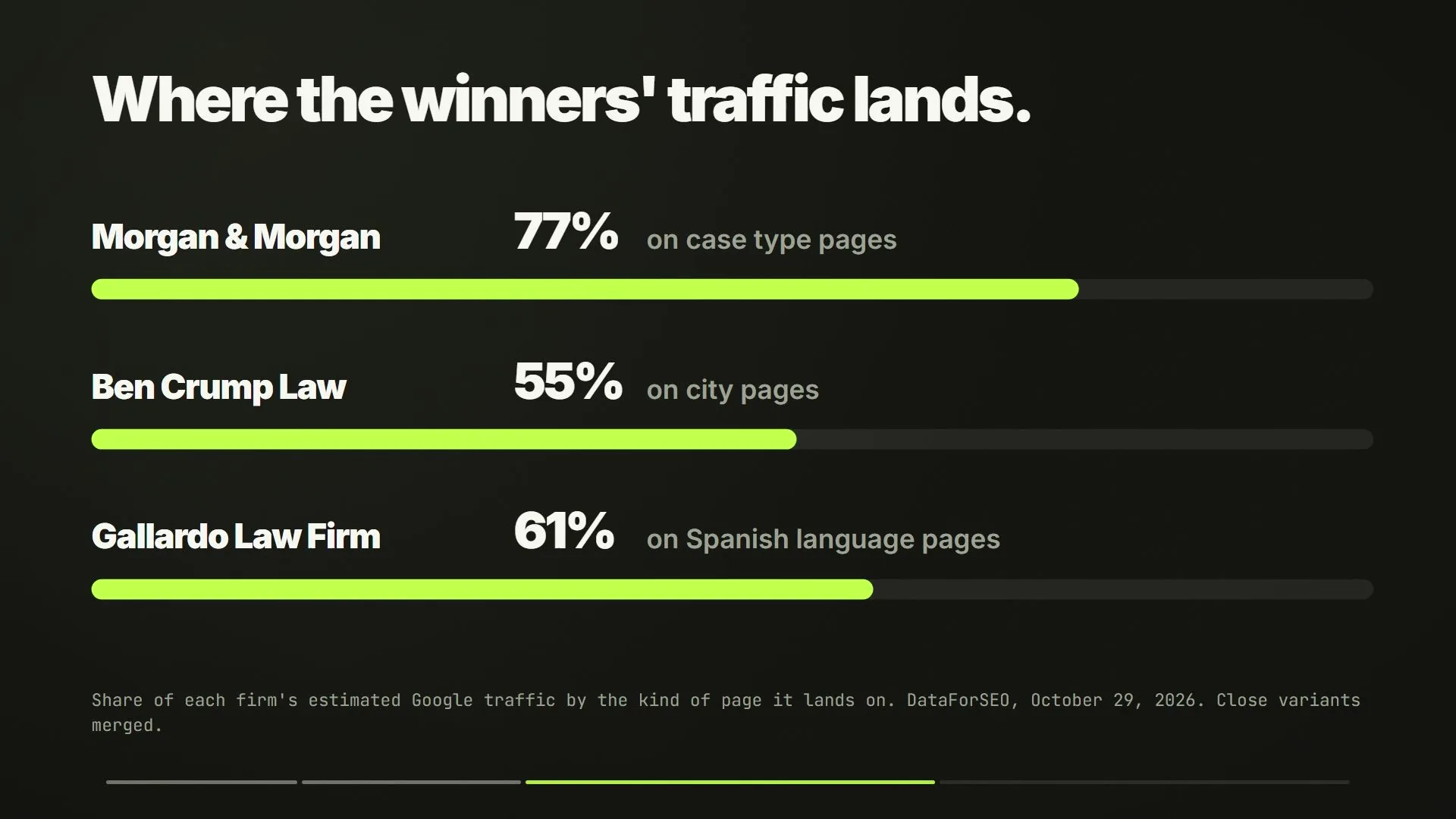
Share of each firm's estimated Google traffic by the kind of page it lands on. DataForSEO, October 29, 2026.
Each of them built a different kind of page, but the rule underneath is the same: one page for one case type, one city or one language. Then do it again.
Make a list in four columns
We adapted this from Sam Dunning's money keyword method. For a New York firm, it looks like this:
| What they search | Where, and who | The choices they weigh | Their problem, in their words |
|---|---|---|---|
| car accident lawyer | Brooklyn | do I need a lawyer for a minor car accident | what to do after a car accident in New York |
| truck accident attorney | Queens | ||
| wrongful death lawyer | the Bronx | ||
| Spanish: abogado de accidentes de auto |
Then check each search's volume, difficulty and cost per click in whatever keyword tool you use, and build the ones that hire first. Cost per click is the quickest signal of all, because advertisers don't keep paying $150 for clicks that never sign.
Look at what Google shows first
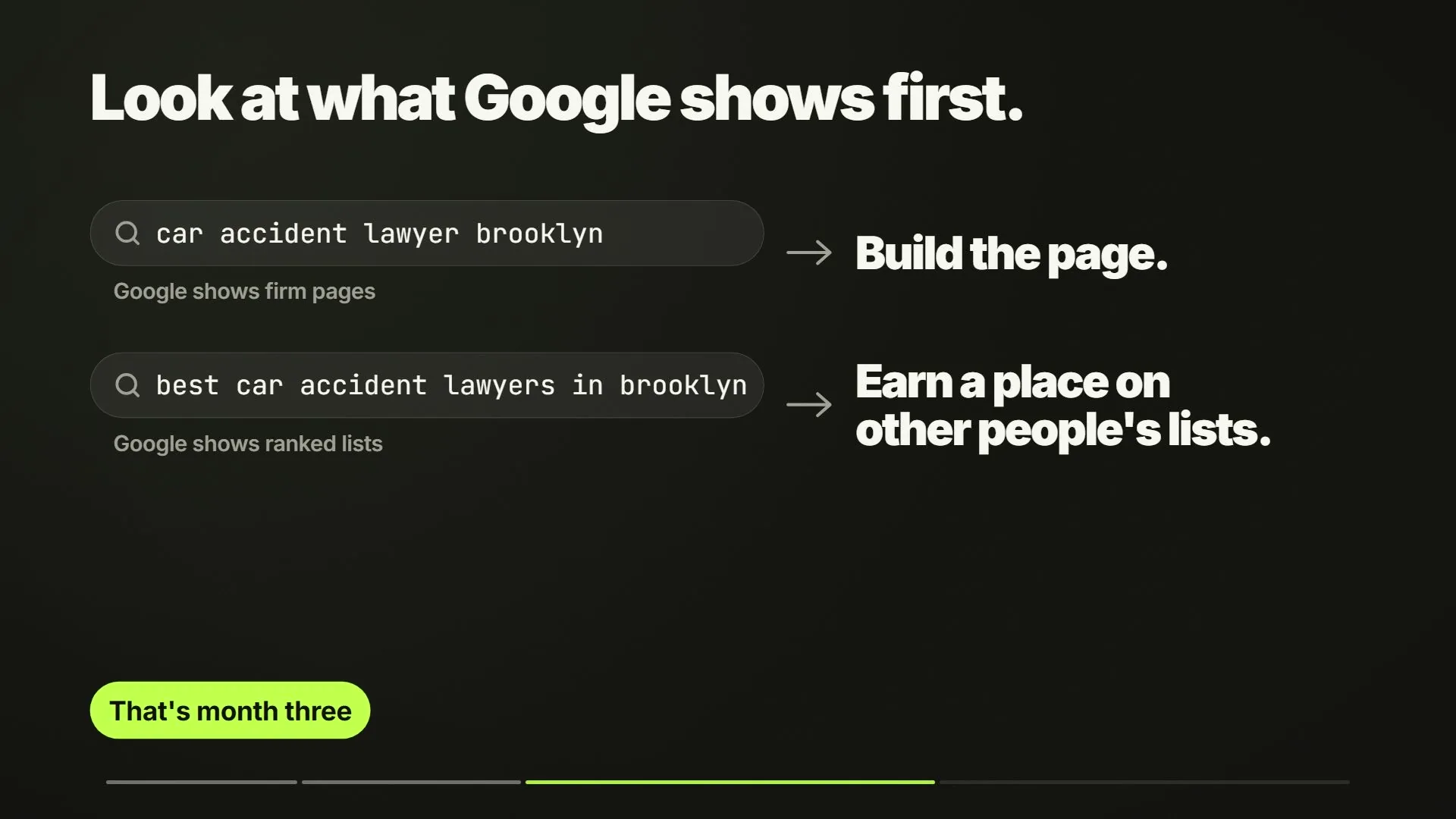
One rule saves a lot of wasted pages. Search each term and look at what's on page one. "Car accident lawyer brooklyn" shows firm pages, so it gets a page of its own. "Best car accident lawyers in brooklyn" shows ranked lists, and a firm can't credibly rank itself the best. For those searches the job is earning a place on other people's lists. That's month three.
What each page needs
- The case type and the city in the title and the main heading
- A short summary first, then the full explanation
- Your state's rules and deadlines, explained simply
- Answers to the questions your intake team hears every week
- Links to the lawyers who handle these cases
- Verifiable results, real reviews, and a phone number people can tap
The two top-ranking pages we read in full were about 3,700 and 7,400 words long. They don't run that long for Google's sake. They answer what a client wants to know before they call.
A warning about volume
In October 2026, a New Jersey and Pennsylvania injury firm put up 90 new pages answering injury questions. When we checked on October 29, none of them were on Google's first page. Publishing more didn't get them there. So build from your list, one page at a time. We'll check those 90 pages again in December.
Days 61 to 90: get onto the lists ChatGPT checks
Start with the sources you wrote down in week one. Most of them will be rankings. Here's how the big ones say they choose lawyers, in their own words:
| Ranking | How it says it picks lawyers |
|---|---|
| Chambers | Firm submissions, plus interviews and surveys. "Submitting to Chambers is free." |
| Best Lawyers | Peer review by attorneys in the same region and practice area |
| Super Lawyers | "Peer nominations and evaluations are combined with independent research" |
| Doyle's Guide | Peer review. Rankings "cannot be purchased" |
The line we don't cross
Under the ABA's Model Rule 7.2(b), which most states have a version of, a lawyer can't give anything of value for a recommendation. So if someone offers your firm a paid spot on a "best lawyer" list, say no. A place on a ranking has to be earned.
Then the bar
Keep your registration current and your record clean, because ChatGPT checks both. Then look at your city or state bar's lawyer referral service, since ChatGPT searched New York's. Rule 7.2(b) does let a lawyer pay the usual charges of a qualified lawyer referral service, but check your own state's version first.
Measure what pays you
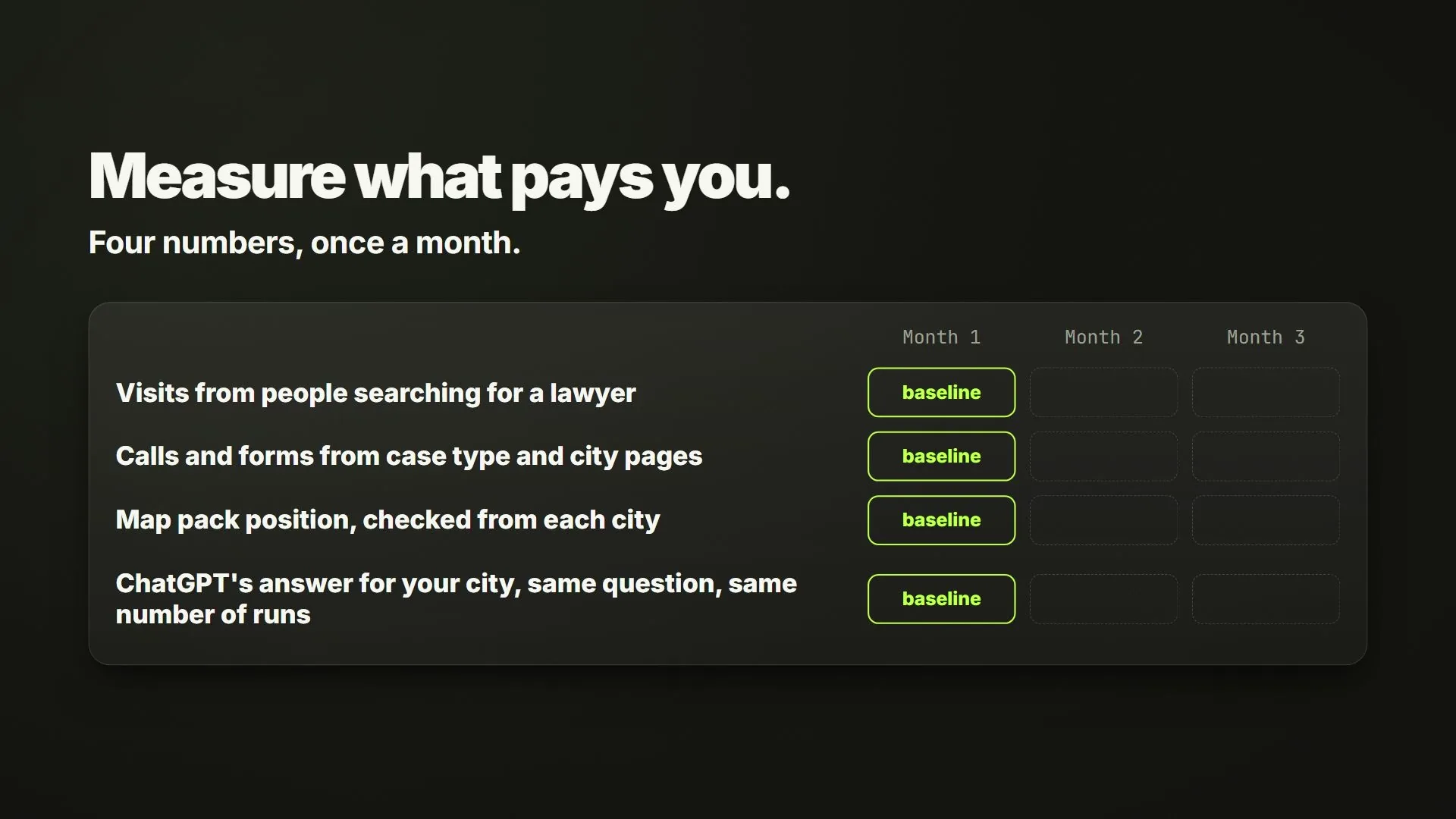
All the way through, track four numbers once a month:
| The number | Where it comes from |
|---|---|
| Visits from people looking for a lawyer | Your hire-intent searches from week one, in Search Console. Not total visits. |
| Calls and forms from case type and city pages | Call and form tracking, recorded against the page they came from |
| Map pack position for your top searches | Checked from each city you serve |
| ChatGPT's answer for your city | The same question, asked the same number of times, written down |
Ask your intake team to record where every new client heard of you, and match it to the case once it's signed. Without that step you can count calls, but not cases.
The 90-day plan on one page
| Days | Focus | Do this | Done when |
|---|---|---|---|
| 1 to 14 | Find out where you stand | Split your traffic three ways, see where lawyer searches land, list case types and cities, check the map pack from each city, ask ChatGPT ten times | You have two lists: pages you're missing, and sources you're missing from |
| 15 to 30 | Fix what you already have | Business Profiles, attorney bio pages, weekly reviews, searches on page two | Every office and every attorney page checked |
| 31 to 60 | Build the pages people hire from | One page per case type, city or language, in the order your list says | The top gaps on your list each have a page |
| 61 to 90 | Get onto the lists ChatGPT checks | Submissions to the rankings that fit, bar record and referral service | Every submission deadline is in the calendar |
| Every month | Measure what pays you | The four numbers, on the same day each month | You have a baseline and three readings |
What 90 days can and can't do
We won't promise you rankings in 90 days, and nobody controls what ChatGPT says. New pages can take weeks or months to rank, and some rankings only accept submissions once a year.
What 90 days does get you is the groundwork done in the right order, and a baseline to measure against every month after. That's why the plan starts with the work closest to the searches you already show up for.
A few more lines we hold for every firm:
- No paid spots on "best lawyer" lists (ABA Model Rule 7.2(b))
- No fake or bought reviews (the FTC rule from 2024)
- No "specialist" or "certified" claims unless an approved body certified the lawyer (ABA Model Rule 7.2(c))
- Past results only where they can be verified, and in the form your state allows
- Your state's filing rules respected. Texas, for one, wants most advertising filed with the State Bar.
This is how we work, not legal advice. Check your own state bar's rules.
Frequently asked questions
How long does a law firm marketing plan like this take to work?
Fixes to your Business Profile, reviews and bio pages can move things within weeks, because they touch searches you already show up for. New pages usually take longer, often months. The 90 days is the order of work and a baseline, not a deadline for results.
Can a law firm pay to be recommended by ChatGPT?
No. There's no paid placement inside ChatGPT's answers, and paying a ranking to list you as a top lawyer runs into ABA Model Rule 7.2(b). What you can do is earn a place on the rankings and records ChatGPT reads, and make sure your own pages agree with them.
Does this plan work outside personal injury?
Yes. Personal injury is our worked example because that's where we've run the most tests. Family, immigration, criminal defense and estate planning firms follow the same four phases. Only the case types, the rankings and the cities change.
Do one thing this week
Ask ChatGPT who the best lawyer for your main case type is in your city, ten times. If it doesn't name you, write down every source it cites, and check which ones you're missing from. That list is the start of your month three.
If you want the full version, our law firm playbook is a free 12-page PDF with the data behind every number here. And if you'd like us to run the first two weeks of this plan for your firm and your city, book a call and we'll walk you through what we find. You can also see how we run law firm SEO.
Sources
- Google results for "car accident lawyer new york", searched from New York, November 3, 2026 (DataForSEO)
- ChatGPT with web search (gpt-6.1-sol): one answer for New York, November 3, 2026, and 32 answers across Los Angeles, Houston, Philadelphia and Atlanta, October 27, 2026
- Google traffic estimates and cost per click for 11 personal injury firms in 8 US cities, DataForSEO, October 29, 2026. Visits are estimates, not the firms' own analytics.
- The methodology and submission pages of Chambers, Best Lawyers, Super Lawyers and Doyle's Guide, read November 3 and 4, 2026
- ABA Model Rules 7.2(b) and 7.2(c); FTC Trade Regulation Rule on the Use of Consumer Reviews and Testimonials (16 CFR Part 465); State Bar of Texas advertising review
Each test used one question and one model, so read the numbers as a sample, not a law.